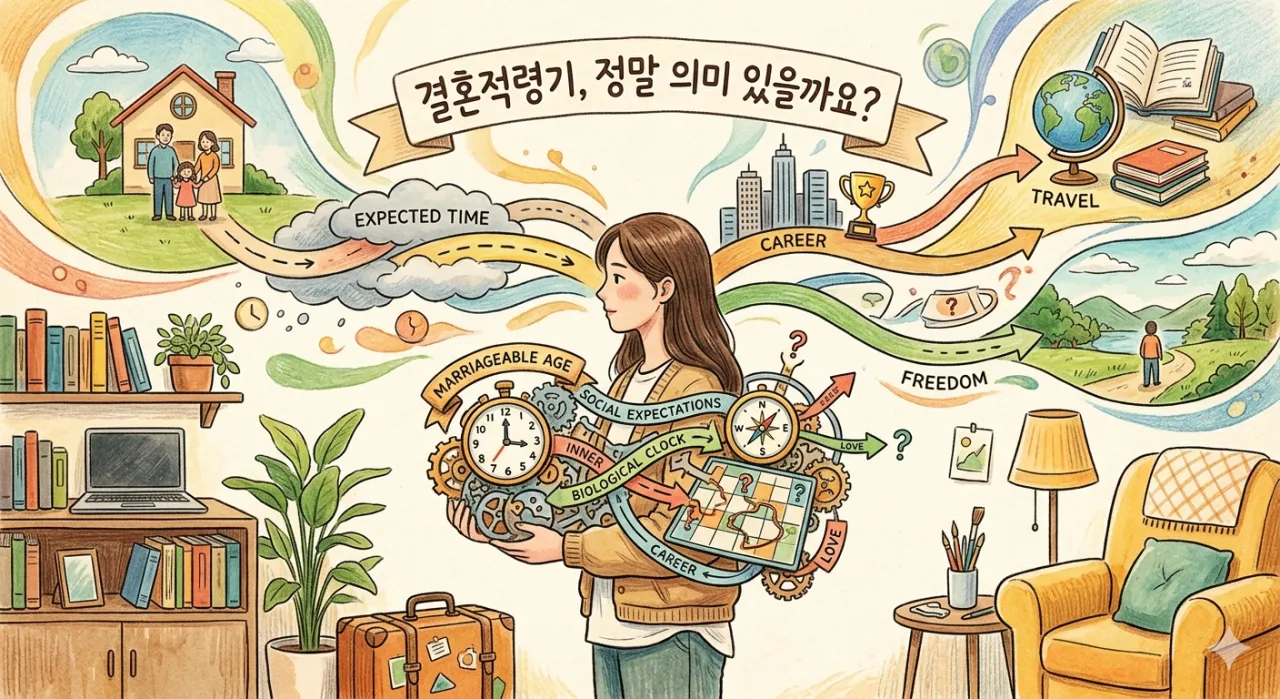
A Conversation at the Lunar New Year Table
During the Lunar New Year holiday in February 2024, I found myself thinking about this topic again while sitting with relatives. Once the meal was mostly over, the conversation naturally turned to marriage. One person said, “You should start thinking about it soon,” and another said, “People say it’s okay to marry late these days, but there’s still a right time for it.”
To the person saying it, it may have sounded like a casual joke. But the face of the person hearing it did not look that way. A younger cousin who was sitting there had only recently started working and was not dating anyone.
Later, when we had coffee separately, that cousin said, “It’s not that I don’t want to get married. It’s just that my own life still doesn’t feel settled, and when people keep telling me I’m late, it makes me feel like I’ve failed at something.” Hearing that made me realize how heavy the phrase “marriageable age” can feel.
“When are you getting married?”
Has anyone really gone through life without hearing that question at least once? When relatives gather during the holidays, it comes up at least once. When your parents mention that the child of one of their friends got married, it comes up again. Even after attending a friend’s wedding on the weekend, it crosses your mind for no reason. When wedding photos appear on social media, you may sincerely feel happy for them, but a small part of your own heart can still feel unsettled.
I also used to accept the phrase “marriageable age” quite naturally. There was a certain atmosphere around it: men should think about marriage around a certain age, women around a certain age, and by that point, marriage should at least be on the table.
But as I watched friends around me, my thinking changed a lot. Some friends married at an age that looked “just right” to other people, but after marriage they struggled because parts of their lives and relationships were not ready. On the other hand, some friends heard over and over that they were “getting too late,” but because they married when they themselves were prepared, they built much more stable lives.
Another friend did not avoid marriage because they did not want it. They kept delaying it because of housing and job stability. From the outside, they looked like someone who “wasn’t getting married because their standards were too high,” but in reality, the practical burden was simply too large.
Watching people like that made me wonder. Is “marriageable age” really something decided by age? Or is it just a familiar social label we have become used to repeating?
Marriage is not homework you automatically have to submit when you reach a certain age. Much more important is who you are at that age, what kind of relationship you want, and whether you are ready to build a life with someone.
This article is not meant to answer the question, “At what age should you get married?” Rather, I wanted to write it for people who feel rushed by the phrase “marriageable age,” because there are things worth looking at before age.
When You Come Back From a Friend’s Wedding, You Start Checking Your Own Life Too
There are times when you feel strangely complicated after coming back from a friend’s wedding. Your congratulations are completely sincere. When you see your friend walking in beautifully dressed, their parents wiping away tears, and the couple standing hand in hand, your heart feels warm.
But on the way home, you somehow start thinking about your own life too. “When will I stand there?” “Am I living well right now?” “Does it feel like everyone else is moving on to the next stage while I’m the only one standing still?” “Is it strange that I still don’t have marriage plans at this age?”
It becomes stronger when news of marriages around you starts coming one after another. At first, one or two friends get married. Then at some point, wedding photos start appearing frequently in group chats. Someone finds a newlywed home. Someone else shares news about a baby.
From then on, marriage no longer feels like a vague future. It starts to feel like a reality you can compare yourself against.
What I saw often around me was not people being shaken because they had no desire to marry. They were shaken by the feeling that “I’m the only one falling behind.”
One friend often said this after entering their early thirties. “I don’t think I’m ready enough to seriously think about marriage yet, but when I look at the atmosphere around me, I feel like I’m late.”
That felt very real to me. That friend was still building a career, was financially insecure, and did not feel certain about married life. But because so many people nearby were already married or preparing for marriage, the feeling of “I’m falling behind” felt bigger than the fact that they were simply not ready yet.
This is why the phrase “marriageable age” is difficult. It seems to be talking only about age, but in reality it gives people this feeling: “You are late.” “Other people are moving forward. Why aren’t you?” “Your options are starting to shrink.”
When you receive that kind of pressure, marriage stops feeling like a choice you are making for yourself. It starts to feel like something you choose to avoid falling behind.
But marriage is not a line you join to match everyone else’s speed. Marriage is a choice that requires you to ask whether you can actually live that way.
Your heart may be shaken after attending a friend’s wedding. But you should not decide to marry based only on that shaken feeling. Celebration and comparison are different. You can celebrate your friend’s marriage while still looking separately at the pace of your own life.
The “Right Age” From Our Parents’ Generation Is Different From Today’s Reality
It would be unfair to see parents’ worries about marriage as automatically bad. From a parent’s point of view, they often simply want their child to meet a good person and live a stable life. As their child gets older, they may worry that opportunities will shrink, that their child may feel lonely living alone, or that people around them will keep talking.
The problem is that the marriage timeline imagined by our parents’ generation is very different from the reality today’s generation faces.
In the past, many people began working earlier than they do now, and the burden of housing costs was different. Socially, marriage was also seen much more strongly as a natural life step. There was a relatively clear flow: get a job at a certain age, marry, and have children.
But things are different now. Many people start their careers later, and it takes time to secure a stable job. Housing has become a much heavier issue, and even when both partners work, marriage is not an easy decision once you consider living expenses and loans.
One friend said their parents told them this: “When we were your age, we already had children.”
The friend laughed it off, but inside they felt frustrated. “Housing prices were different in your time, and there was also a belief that once you entered a company, life would be somewhat stable. Now, marriage is not something you can do just because you decide you want to.”
Many people will relate to that.
The phrase “marriageable age” often judges the present by the standards of the past. But today’s marriage is not something you can do simply because you have reached a certain age.
You have to consider your economic base, housing, work-life balance, distance from both families, plans for children, and career direction.
Even so, people around you still often look only at age. “You should start soon.” “It gets harder if you’re too late.” “You should marry when there’s a good person.” “If you’re too picky, you won’t be able to marry.”
Of course, not everything in those words is wrong. It is true that options and concerns change with age. But those words often fail to reflect each person’s real situation.
Marriage is not something you do according to your parents’ generation’s schedule. It is something you must decide within the reality you are living now.
A Marriage at the “Right Age” Can Still Be Hard If You Are Not Ready
The saddest cases I saw around me were couples who rushed into marriage “because of age.” That does not mean they did not like each other. There was affection. But the reason “we are now at the age to do it” played too big a role in the decision.
One friend said this even before getting married. “I don’t have absolute certainty, but we’re at that age and we’ve dated for a long time, so I feel like we should get married.”
At the time, I did not know what to say. They had been together for a long time, both families knew each other, and people around them naturally assumed they would marry.
But once wedding preparations began, the issues they had pushed aside started coming up.
Their money management styles were different. One wanted to combine their salaries and manage them together, while the other wanted to keep finances separate.
Their sense of distance from each other’s families was different. One thought frequent contact with parents was natural, while the other valued independent time as a couple more.
Their conflict styles were different. One needed to talk right away to feel resolved, while the other needed time alone to organize their thoughts before speaking.
These differences had existed while they were dating, but they had not dealt with them seriously before marriage. They had assumed, “Once we get married, we’ll naturally adjust.”
But marriage does not automatically solve differences. If anything, it makes you face them every day.
Even if the age seems right, a marriage that is not ready can be hard. Liking each other is not always enough. You have to look at whether you can manage money together, share daily life, resolve conflict, set boundaries with family, and carry each other’s weaknesses.
The phrase “marriageable age” sometimes hides these questions. A more important question than “Should I marry at this age?” is this: “Am I ready to build a life with someone right now?” “Can we recognize our differences and still adjust?” “Can we talk about the practical problems that will repeat after marriage?”
Age will not live your marriage for you. In the end, married life is something two people must practice every day.
Marrying Late Is Not Always a Bad Thing
On the other hand, I also know people who married later. They married at ages that might once have been called “late,” but many of them are living more stably than expected.
One friend married in their mid-to-late thirties. For a while, people around them worried a lot. Their parents also said, “What will you do if it gets even later?” and the friend said they had once felt rushed too.
But that friend did not rush into marriage. They spent quite a long time thinking about what kind of life they wanted, what kind of person they could live with, what they could compromise on, and what would be difficult.
Perhaps because of that, their conversations while dating were practical from the beginning. How should money be managed? How much alone time does each person need? What kind of relationship with both families feels appropriate? What are their thoughts on children? When conflict arises, what way of resolving it would be least exhausting for both people?
They talked about these things a lot before marriage. Their wedding was not extremely flashy, but the two of them seemed to have clear standards. More than anything, it did not feel like “we’re late compared to others, so we need to hurry.” It felt like “we are ready now.”
Seeing that changed how I thought about late marriage. Marrying late is not automatically risky. If anything, when someone understands themselves more deeply and knows what matters in a relationship, they may be able to make a more stable choice.
Still, there are things to be careful about in later marriage. After living alone for a long time, a person’s lifestyle may become stronger. Their routines and standards may be clear, so adjusting to someone else can feel frustrating. Their expectations may also be higher because they have accumulated more relationship experience.
But that does not mean problems appear simply because someone is older. What matters is whether they recognize the parts of themselves that have become fixed and whether they are willing to adjust with a partner.
More important than timing is flexibility. Can I avoid insisting only on my way? Can I learn the other person’s lifestyle? Can I accept both the comfort of living alone and the responsibilities of living together?
If those things are present, age may be a much less absolute standard than people think.
What Matters More Than Marriageable Age Is Psychological Readiness
When people ask when they should get married, many first think of age. Late twenties, early thirties, mid-to-late thirties. But when I look around, something mattered much more than age.
It was psychological readiness.
Simply put, it is the emotional readiness to live with someone. It includes many things. Knowing what kind of person you are. Knowing what situations make you sensitive. Being able to express disappointment in words. Being able to talk through conflict instead of running away or attacking. Accepting that the other person is different from you. Understanding that marriage is not only an extension of dating, but a daily life.
Without this preparation, marriage can be difficult no matter how appropriate the age seems.
One friend said this before marriage. “I thought I was a pretty easygoing person, but during wedding preparations I realized I actually have a strong desire for control.”
That friend was someone who became anxious when things did not go according to plan. It did not show strongly while dating, but once wedding preparations involved budgets, schedules, parents’ opinions, and venue decisions, that tendency became much stronger.
Fortunately, the friend did not deny it. They realized, “When I get anxious, I rush the other person,” and later tried to organize their emotions before making important decisions.
I think that is a very important attitude in marriage preparation. Perfect people do not get married. People who know their shortcomings and can adjust have a better chance of doing married life well.
The phrase “marriageable age” asks, “How old are you?” But readiness for marriage asks questions like these: “Can I explain my feelings?” “Do I try to understand the other person’s differences before trying to fix them?” “Can we return to the same side after a fight?” “Am I ready to share the responsibilities of daily life?” “Can I talk even when my partner differs from my expectations?”
If you cannot answer these questions, reaching a certain age does not mean you are ready for marriage.
Dating for a Long Time Does Not Automatically Mean You Are Ready for Marriage
There is a misconception I have seen surprisingly often around me. “We’ve dated for a long time, so now we should get married.”
Of course, time spent together has meaning. You know each other’s personalities, you have memories, and there may be a sense of stability in the relationship.
But a long dating period does not necessarily mean that the couple is ready for marriage.
Some couples date for five years without having many deep conversations. They date well, travel well, know each other’s friends, but avoid talking about life after marriage.
How will money be managed? Do they want children? What distance should they keep from parents? What do they expect from each other when work becomes hard? How should they resolve things when they are angry?
These conversations do not automatically accumulate just because two people dated for a long time.
On the other hand, couples who have dated for a relatively shorter time may be more prepared if they have talked deeply about important issues.
One friend, while considering marriage with a long-term partner, said this: “We dated for a long time, but once we started talking about marriage, I realized there was so much we didn’t know about each other.”
That stayed with me.
Dating for a long time may mean familiarity. But familiarity is not the same as readiness.
What you should look at before marriage is not only the length of the relationship, but its depth. Have we talked about difficult topics instead of avoiding them? Can we know each other’s weaknesses and still stay together? Have we experienced resolving conflict? Have we imagined concrete issues in daily life?
Those processes are necessary. What matters more than marriageable age is the stage the relationship has reached.
A Marriage Pushed by Social Pressure Shows Afterward Too
“You should get married now.” “If you wait too long, there won’t be good people left.” “Your parents are waiting too.” “All your friends have gone already. When are you going?”
When you keep hearing these words, your heart cannot help but shake. At first you brush them off lightly, but when they repeat, you start thinking without even realizing it. “Am I really too late?” “Even if the person I’m dating is not perfect, should I just do it around now?” “What if waiting makes it even harder?”
I have seen people around me try to rush marriage because of this pressure. I understand that feeling. Being asked the same question again and again is exhausting, parents’ worries feel burdensome, and comparison with others is painful.
But if you decide to marry because of external pressure, then when small conflicts arise after marriage, these thoughts may come up: “Did I really choose this because I wanted it?” “Should I have thought a little more back then?” “Was I pushed by my parents, by age, or by pressure?”
When these thoughts appear, the strength to endure conflict weakens.
Every marriage has difficult moments. One thing that helps hold the relationship during those moments is the sense that “I chose this.” Not because someone ordered you to, not because age pushed you, but because you chose this person and this life.
That is why voluntary choice matters so much in marriage. You can consider what people around you say. You can listen to your parents’ worries. You also need to consider age and reality. But the final decision must be yours.
Marriage is not something you do to reassure other people. It is the choice of the life you will live.
Questions to Ask When You Are Thinking About When to Marry
When the phrase “marriageable age” shakes you, I think it helps to change the question instead of focusing on age. Rather than asking, “How old am I now?” ask, “What am I ready for right now?”
These are questions worth discussing alone or with your partner at least once.
1. Questions about self-understanding
“Why do I want to get married?” “Can I tell whether this is loneliness, a desire for stability, or a real wish to live with someone?” “What life standards are very hard for me to compromise on?” “In what situations do I become anxious or sensitive?” “What relationship patterns do I repeat?”
2. Questions about relationship readiness
“Have we talked about money, family, children, and careers?” “When I express hurt, does the other person listen or become defensive?” “Can we return to conversation after a fight?” “Do I know which of the other person’s weaknesses may repeat after marriage?” “Even then, am I willing to adjust together?”
3. Questions about practical readiness
“Is our housing plan after marriage realistic?” “Have we talked about living expenses and savings?” “Do we know how much time and money each person’s family requires?” “Have we talked about whether we want children and, if so, when?” “Can we respect each other’s career and personal time after marriage?”
4. Questions about voluntary choice
“Am I really choosing this marriage?” “Am I rushing because of my parents, my age, or other people’s eyes?” “Am I choosing marriage because I feel anxious without it, or because I want to live with this person?” “Would I still choose this relationship even if there were no wedding right now?”
This does not mean you need perfect answers to all these questions before getting married. But at the very least, you should be able to talk about them without avoiding them. Marriage preparation is not made only of certainty. It is also the process of checking uncertain parts together.
The MATE Test Can Be a Tool for Looking at Readiness Instead of Age
When thinking about when to marry, many people look at age first. But in reality, the two people’s lifestyle, conflict style, level of closeness, and way of managing life often matter more than age.
For example, one person may feel secure in a relationship where they are together every day, while the other needs time alone to breathe. One person may need to talk immediately when a problem arises, while the other can only speak after taking time to organize their thoughts. One person may feel comfortable with schedules and budgets, while the other feels suffocated by overly detailed rules.
These differences are not solved just because two people are the same age. If anything, you need to know them before marriage so you collide less afterward.
A tool like the MATE test can be used as a starting point for talking about these differences. When you look at areas such as closeness, daily rhythm, conflict handling, and operating style, you can ask a more important question than “Are we compatible?”
“Where are we different, and how can we adjust?”
A test cannot decide whether you should marry. But it can turn vague anxiety into concrete conversation. If you are worrying about marriageable age, it is better to look not only at age but also at the two people’s readiness.
Conclusion: What Matters More Than Marriageable Age Is “The Marriage I Choose”
The phrase “marriageable age” still has power. It makes some people rush, makes some people anxious because they feel late, and makes some people think about marriage even when they are not ready.
But what I have learned from people around me is clear. Marriage does not become easy just because the age is right. Marriage does not automatically become difficult just because the age is late.
What matters more than age is readiness. How well do I know myself? Have I had realistic conversations with my partner? Have we talked about money, family, daily life, conflict, and children? Can we adjust our differences instead of trying to fix each other? Most of all, is this marriage my choice, not the result of outside pressure?
Marriage is not a door you must enter faster than other people. It is a choice about the life you can handle.
Just because a friend got married does not mean you have to marry right away. Just because your parents worry does not mean you need to rush into a marriage you are not ready for. On the other hand, endlessly waiting until every condition is perfect may not be the answer either.
What matters is looking honestly. Do I want marriage? Why do I want it? Am I ready to build a life with this person? Can we deal with our differences?
When you can start answering these questions little by little, that may be the right time for marriage for you. Marriageable age is not a number written on a calendar. It is closer to the moment when you are ready to choose.
Frequently Asked Questions
Q. Is it too late to marry after the mid-thirties?
Not necessarily. What matters more than age itself is readiness for marriage. If you understand yourself well, know your economic reality, and have talked enough with your partner about lifestyle and conflict resolution, marriage after the mid-thirties can be stable. However, if you have lived alone for a long time, your lifestyle may have become strong, so it is good to consciously check the flexibility needed to live with someone.
Q. If I have dated someone for a long time but still do not feel certain about marriage, is there a problem? Not necessarily. Dating for a long time does not automatically create readiness for marriage. In fact, you may lack certainty precisely because you have dated for a long time while avoiding important conversations. Talk specifically about money, family, children, housing, careers, and conflict resolution. It can help you separate vague anxiety from real problems.
Q. What should I do if my parents keep pushing me to get married? Rather than completely ignoring your parents’ worries, it helps to calmly explain your own standards. “I’m not taking marriage lightly. But rather than rushing because of age, I want to do it when I’m ready enough to handle it.” Saying it this way is better than becoming defensive. What matters is not only persuading your parents, but having a clear standard for your own choice.
You might also enjoy:
- The Most Important Part of Wedding Preparation Is Not the Ceremony
- Why People Who Know Themselves Are More Stable in Love and Marriage
Q. Can we say that marriageable age has no meaning at all?
As a social standard, the idea of a marriageable age is becoming weaker. But that does not mean age should be ignored completely. Economic circumstances, plans for childbirth, career direction, and family expectations can change with age. Still, age is only one condition. The core standards for deciding marriage are readiness, relationship maturity, voluntary choice, and a realistic plan for daily life.
Q. I cannot tell whether I truly want marriage or whether I am anxious because of social pressure. It helps to ask yourself whether you still want marriage when you are alone. Avoid asking right after a friend’s wedding or a holiday gathering, when pressure is high. Ask when your mind is relatively calm. “Do I want a wedding, or do I want married life?” “Do I want to share daily life with someone, or do I hate feeling left behind?” “Do I need the status of being married regardless of this person, or am I looking forward to a life with this person?” As you answer these questions, the direction of your heart may become clearer.