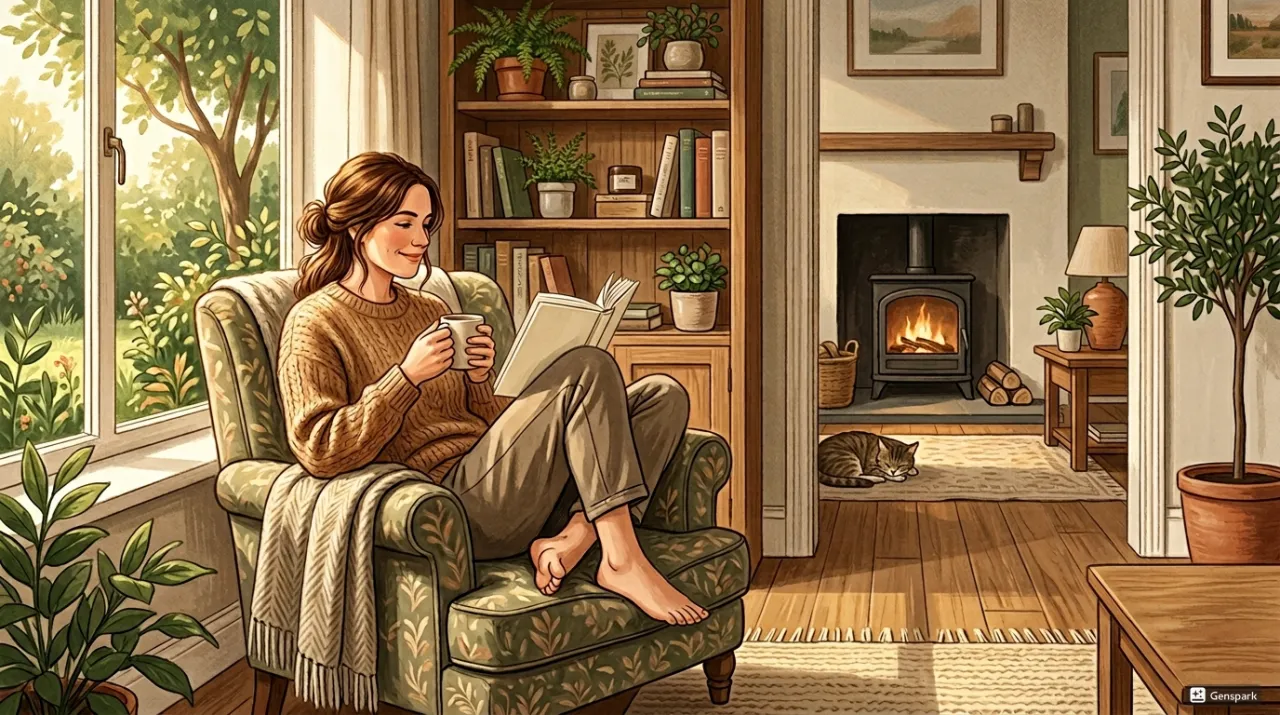
Before I could say, “I want to be alone”
In September 2023, someone I knew who was in a relationship confessed to a strange sense of guilt. “It’s not that I don’t love them, but I really want one weekend day to myself.” The problem was that they kept making plans because they were afraid their partner would feel hurt if they said that out loud.
They met on Saturdays, met again on Sundays, and even talked on the phone on weekday evenings. The relationship was happy, yet their body and mind were becoming more and more exhausted.
They did not want to be alone because they disliked their partner. If anything, they needed time alone to recharge so they could keep the relationship going well for a long time.
But because they could not say that, at some point dates began to feel more like an obligation than something to look forward to. Hearing that made me think that alone time is not the opposite of a relationship.
“I just want to rest by myself today.”
There was a time when it took me a very long time to say that sentence.
It was not because I disliked the other person. It was not because my feelings had cooled. It was not because I wanted to meet someone else.
I simply wanted to be alone.
I wanted to lie in bed, scroll on my phone, fall asleep, and not have to explain anything to anyone or say a single word. Going to a cafe and reading a book would have been nice, too. Even buying a cup of instant noodles at the convenience store near my house and eating quietly would have felt good.
But in a relationship, that sentence felt strangely difficult.
I worried that if I said I wanted to be alone, the other person might think:
“Do they not want to be with me?” “Have their feelings cooled?” “Why would someone want to be alone when they have a partner?” “Is their own time more important than me now?”
I used to think that way, too. I thought a good partner should want to meet often, should think of their partner first whenever they had free time, and should naturally spend weekends together.
But after actually being in relationships, I realized something.
Loving someone does not mean wanting to spend every moment together. Even when the relationship is good, some people need time alone to recharge. When alone time is missing, the love may not be fading; the person may simply be getting tired first.
I felt this most strongly in a relationship I had in my late twenties.
Back then, we contacted each other almost every day, met every weekend, and even saw each other on weekdays when our schedules matched. At first, it was good. It felt good to have someone who wanted to see me, and meeting someone after work felt exciting.
But after a few months, a strange fatigue began to appear.
I did not dislike my partner, but when a plan was made, part of me felt heavy. When a KakaoTalk message arrived, my first thought was not “How nice,” but “I need to reply.” When the weekend came, it did not feel like a day off. It felt like another day when I had to adjust myself to someone else.
At the time, I did not understand my own heart.
“Do I like this person less now?” “Is dating supposed to be this tiring?” “Am I just not suited to relationships?”
I thought those things.
Only later did I realize the truth.
It was not that I lacked love. I lacked time alone.
This article is not about telling people to distance themselves from their partners. It is about how, in order to keep a relationship healthy for a long time, we may need time to return to ourselves just as much as time to move toward each other.
In the summer of 2022, Friday nights slowly became burdensome
The thing I remember most clearly from that relationship is Friday night.
It was around June 2022. Work was quite busy at the time, and by Friday my body was almost completely drained. All week I had met people, sat through meetings, answered messages, and even after leaving work, my head did not turn off easily.
But we met almost every Friday as if it were obvious.
At first, I liked it.
We would meet around 8 p.m. at Sadang Station, have dinner, go to a cafe, and if it got late, take a taxi home. It felt like a date that wrapped up the week.
The problem was that, at some point, that time no longer felt like rest. It felt like one more item on my schedule.
That day was similar.
At 6:40 p.m. on a Friday, I was standing blankly in front of the restroom mirror at work. I needed to get ready to leave, but my body felt so heavy. On my phone, there was a message from my partner.
“What time do you think you’ll finish today?” “What should we eat?” “I’m already hungry lol.”
On an ordinary day, I would have smiled and replied. But that day, even typing a reply felt difficult.
I sent:
“I think I can make it around 8.”
But in my heart, I wanted to say something else.
“I’m too tired today. I just want to go home.” “Can I rest by myself this week?” “It’s not that I don’t want to see you. I’m just too worn out.”
But I could not say it.
I thought my partner would feel disappointed. I thought the mood would get bad for no reason. Telling someone I loved, “I want to be alone today,” felt too cold.
So I met them anyway.
Even during dinner, I was quieter than usual. My partner must have noticed, because they asked:
“Did something happen today?”
I answered:
“No, I’m just a little tired.”
My partner said:
“Then let’s eat quickly, stop by a cafe for just a bit, and go home.”
It was a considerate thing to say, but strangely my heart felt heavier. Because even a quick stop at a cafe was not what I wanted. I did not want to go anywhere.
When I got home that day, it was past midnight. I showered and lay in bed, and for some reason I felt like crying.
We had not had a big fight. Nothing bad had happened. But my heart kept saying:
“I’m so sorry to myself today.”
From then on, Friday nights slowly began to feel burdensome.
It was not because the relationship lacked love. It was because I felt my own time disappearing little by little.
Because I could not say “I want to be alone,” I became increasingly distant
Back then, I could not properly say that I wanted to be alone.
Instead, it began to show in other ways.
My replies became slower. I was less active when making plans. Even when we met, I could not fully focus on the conversation. When my partner expressed affection, my responses became shorter.
Of course my partner sensed it.
One night while we were on the phone, they said:
“You seem different these days.”
I denied it immediately.
“No, I’m just tired from work.”
They asked again:
“Are you tired of meeting me?”
My heart dropped when I heard that question.
It was not that I was tired of them. But it was true that constantly explaining, reacting, and adjusting myself had become difficult.
I should have been honest.
“It’s not that I don’t want to see you. I need time alone to recharge.” “I’m so exhausted lately that I think I need one day a week with no plans.” “If I have that time, I think I can meet you more comfortably.”
But I could not say that.
Instead, I said vaguely:
“It’s not like that. I’m just a bit tired these days.”
My partner could not believe that, and I could not explain my heart clearly.
After that, we misunderstood each other more often.
My partner felt that I was pulling away. I felt that my partner kept holding on to me.
When they asked, “What are you doing this weekend?” I felt pressured. When I said, “I want to rest this week,” my partner felt hurt.
Eventually, both of us became tired.
My partner felt unloved. I felt like I had no room to breathe.
Looking back, the problem was not the desire to be alone itself. The problem was that I expressed that need too late, too vaguely, and too defensively.
A person who needs alone time is not necessarily a cold person. But if that need is not explained, it can feel like coldness to the partner.
In the end, the breakup conversation happened in a cafe on Sunday night
I remember the day that relationship ended.
It was the third Sunday of September 2022. We were in a small cafe near Nakseongdae Station. We had originally planned to just have coffee, but the atmosphere felt heavy from the moment we walked in.
My partner held the cup for a long time and then said:
“I feel like you don’t really want to see me anymore.”
I said no right away.
“That’s not it.”
They said:
“But your actions keep saying that. You contact me less, you look tired when we meet, and when I ask to see you, it feels like I’m burdening you.”
It was hard to argue with that.
I did not dislike them. But it was also true that spending time together no longer felt as comfortable as before.
My partner, almost crying, said:
“I thought that when people dated, they naturally wanted to see each other often. But with you, it feels like I’m always a burden.”
That hurt so much.
Only then did I finally say it properly.
“It wasn’t because I disliked you. I think I needed time alone. I didn’t know how to say that.”
But it was already too late.
They said:
“How can you say that now? For months, I thought your feelings had cooled.”
We talked for a long time that day, but in the end the relationship ended.
On the subway ride home, I looked at my face reflected in the window. I was left with a strange amount of regret.
I did not regret failing to meet my partner more often. I regretted not explaining sooner what kind of person I was.
I was a person who needed alone time. But I did not understand that well myself, and I failed to explain it to my partner.
After that experience, I began to think differently about how important personal time is in a relationship.
Wanting to be alone may not be a sign that the relationship is ending. It may be a recovery signal that is necessary to keep the relationship healthy.
But if that signal is hidden, it can be delivered to the other person as a message that love has faded.
Alone time can be recharge, not loneliness
After the breakup, I doubted myself for a while.
“Am I not suited to relationships?” “Why didn’t I want to meet every weekend?” “My partner liked me, so why did that feel burdensome?”
Then at some point, I understood.
I was not someone who disliked people. I was someone who needed time alone to recover.
If I talked to people all day at work, kept contacting someone after work, and had plans every weekend, something inside me slowly emptied out.
I needed time alone to organize my emotions. I needed time to eat alone, listen to music, take walks, and say nothing before I could meet people again.
After that, I began to distinguish between being alone and being lonely.
Loneliness is being alone when you do not want to be. It is the pain that comes when you want connection but cannot reach it.
But alone time can be different.
Time I choose for myself. Time to organize my emotions. Time to meet myself again after pushing myself aside to adjust to someone else. Time to refill my energy so the next meeting can be more comfortable.
That time is not an escape from the relationship. It can be time that helps me return to the relationship.
I could meet my partner more comfortably only after spending time alone well.
After a day of saying nothing and resting, I could listen better the next day. After walking alone, I felt less irritable when talking on the phone. After reading by myself in a cafe, I had more things to talk about on a date.
That was when I realized this:
A person who spends time alone well does not necessarily love less. They may simply be recovering their own energy so they can enter the relationship in a healthier way.
A good relationship is not one where two people are attached all the time
After that breakup, I became a little more cautious when dating.
Even when I met someone, I tried not to make plans too frequently from the beginning. I tried not to force myself to make time just to look good. I tried to say a little earlier that I was someone who needed time alone.
Then, in the spring of 2023, I met someone.
It was not easy to bring this up at first. But after we had met a few times, I carefully said it one Saturday afternoon.
We were sitting by the window in a cafe in Yeonnam-dong, and it was raining a little outside.
I said:
“To be honest, I get tired if I fill my whole weekend with plans.”
The person asked:
“Are you the type who needs time alone to rest?”
I answered, a little nervous:
“Yes. It’s not because I dislike someone, but because my energy comes back when I’m alone. I once had a relationship that became hard because I couldn’t explain that well.”
They thought for a moment and said:
“Then I’d rather you tell me that from the beginning. That’s much better than not saying anything and slowly pulling away.”
Hearing that relieved me.
After that, we naturally created time for ourselves.
We might spend one part of Saturday together, but leave Sunday morning as our own time. We did not have long phone calls every weekday. On busy days, we simply exchanged short check-ins. If one of us said, “I want to rest alone today,” we tried not to treat it as a crisis in the relationship.
At first, I was still a little anxious.
“Is it okay even if we are not attached to each other this much?” “Will the relationship become too dry?”
But it was actually the opposite.
When we met after spending time separately, we had more to talk about. Hearing about the day the other person spent alone helped me know their world a little better. When I had rested by myself, I could go out to meet them in a better mood.
In that relationship, I felt for the first time:
A good relationship may not be one where people are together twenty-four hours a day. It may be one where each person lives their own life well, then meets again and shares the day.
The quality of the time together mattered more than the amount of time together.
To avoid hurting someone, “I want to be alone” needs an explanation
The need for alone time should be expressed carefully.
If you only say, “I want to be alone,” the other person can easily feel hurt.
Especially for someone who values closeness, those words can sound like rejection.
“Do they not want to be with me?” “Has our relationship cooled?” “Why are they pushing me away?”
Those thoughts can come up.
So now, when I need alone time, I try to explain the reason together with the request.
“I’m not trying to avoid you. My energy is just really low these days, so I want to rest by myself for a day.” “If I rest alone, I think I’ll be able to meet you more comfortably.” “I want to postpone today’s plan, but I want to see you properly this weekend.” “I’m telling you because I think it’s better than quietly pulling away.”
When it is said this way, the meaning changes.
The request for alone time no longer sounds like a wish to leave the relationship. It can sound like a wish to return to the relationship in a healthier state.
The partner should also be able to ask questions.
“How much alone time do you need?” “Is one day enough?” “Do you want no contact at all, or are short check-ins okay?” “How should I understand it so I don’t feel hurt?”
When this conversation exists, alone time becomes an agreement rather than a misunderstanding.
The important thing is not to disappear without saying anything.
Needing time alone does not mean suddenly cutting off contact, repeatedly avoiding plans, or answering only “just because” when the other person asks. If you do that, your partner cannot help feeling anxious.
Healthy alone time includes explanation. Avoidance pulls away without explanation.
That difference is big.
Alone time and avoidance are different
The desire to be alone is not always healthy.
I think this part needs caution.
If alone time recharges you and allows you to return to the relationship, it is close to healthy solitude. But if alone time becomes a way to keep avoiding the other person, it may be avoidance.
For example, there is this difference.
If you rest alone and then begin to want to see your partner again, it may be recharge. If you rest alone and still want to keep avoiding contact and conversation, it may be avoidance.
If you can explain your need before taking alone time, it may be a healthy boundary. If you disappear without explanation or become irritated whenever the other person asks, it may be avoidance.
If you organize your emotions while alone, it may be recovery. If you only keep thinking about your partner’s flaws and move toward cutting off the relationship, it may be avoidance.
I used to be unable to distinguish the two clearly.
At first, I genuinely wanted to be alone because I needed rest. But because I could not say that and kept enduring it, I eventually began wanting to avoid the other person entirely.
In other words, because I did not get healthy alone time when I needed it, it turned into something like avoidance.
That is why people who need alone time should be even more honest.
“I’m someone who recharges by being alone.” “I need this time so I can be more stable in the relationship.” “But I’m not trying to avoid you.”
These explanations matter.
And after spending time alone, there should also be an action that reconnects.
“I rested well today. Thank you for understanding.” “Should we talk tomorrow evening?” “I want to spend time together this weekend.”
Those words help the other person feel reassured.
Alone time should be time for returning to the relationship, not time for leaving it.
People who need closeness and people who need independence easily misunderstand each other
The reason alone time often becomes a source of conflict is that people feel secure in different ways.
Some people feel loved when they contact and meet their partner often. They feel the relationship is stable when they share a lot of everyday life.
To such a person, “I want to be alone” can sound quite unsettling.
On the other hand, some people feel comfortable in a relationship only when they have time alone. If they are constantly attached to someone, they can become emotionally drained and even feel suffocated, even if they like the person.
When these two types of people meet, they can easily misunderstand each other.
The person who values closeness may look at the independent person and think:
“Why do they like me less?” “Why do they keep prioritizing their own time?” “If they love me, shouldn’t they want to be with me more?”
The independent person may look at the person who values closeness and think:
“Why do they keep needing confirmation from me?” “Why can’t they understand that I want to rest alone?” “Does loving someone mean spending every moment together?”
Neither side is wrong. They simply feel love in different ways.
My past relationship failed partly because we did not understand this difference properly.
My partner felt love through frequent meetings and frequent contact, while I was someone who could express love again only after having time alone to recover.
We should have talked about it as a difference in style. Instead, we interpreted each other as “someone whose feelings had changed” and “someone who gives pressure.”
If it were now, I think I would say this:
“It seems like you feel secure when we are connected often, and I seem to need alone time to keep my sense of stability. Let’s find a way that works for both of us.”
Maybe the outcome would have been different if we had had that conversation.
I need my own life even inside a relationship
Alone time does not just mean resting.
Time with my own friends. Time to exercise alone. Time to read. Time to walk without a purpose. Time for hobbies. Time with family separately. Time to simply rest without thinking.
All of these are “my time.”
When a relationship begins, your own life sometimes shrinks.
You exercise less, see your friends less, stop doing the hobbies you used to do alone, and your weekend plans become centered entirely on your partner.
At first, this feels good. In the beginning of a relationship, time with the other person is often the most enjoyable thing.
But over time, it can become a problem.
If my entire life moves into the relationship, my partner’s one reaction can shake my whole day. If my partner is busy, my time becomes empty. If my partner is in a bad mood, my mood collapses with it.
When a relationship becomes my whole life, love becomes heavy.
After experiencing this, I now try to leave some of my own life intact even when I am dating.
Exercising alone once or twice a week. Meeting a friend separately once a month. Leaving weekend mornings as time to rest alone. Continuing something I like regardless of my partner.
I once thought these things would weaken a relationship, but they actually made it healthier.
When I have my own life, I cling less to my partner. When I have my own time, I can respect my partner’s time. When I am somewhat okay by myself, I appreciate our time together more.
It is important not to lose myself inside a relationship.
Love sometimes looks like two people becoming one, but in reality, it lasts longer when two whole people meet each other.
After marriage, alone time needs to be even more intentional
When dating, it is relatively easy to create alone time.
You each have your own home, and days without plans naturally become time alone. Reducing contact a little can also create personal time.
But marriage is different.
You share a home. Even after work, you are in the same space. Weekends naturally become time together. Housework, family, money, and life plans continue to overlap.
That is why alone time needs to be even more intentional after marriage.
I know one married couple who does this well.
They set aside Saturday mornings as each person’s own time.
One person goes to the gym, and the other sleeps in or reads at home. After lunch, they go grocery shopping together or watch a movie.
At first, I found it interesting.
“You’re married, but you spend Saturday morning separately?”
But the couple said that having that time actually made Saturday afternoons more comfortable.
One of them said:
“Before, I felt an unspoken pressure that we had to do something together from Saturday morning. But after resting separately and meeting again, we’re less sensitive.”
That stayed with me.
Being married does not mean sharing every resting moment. If anything, because you are married, you need to agree more intentionally on personal time.
When each person’s rest time is agreed on, it becomes less frightening when the other person wants to be alone.
Instead of thinking, “Are they avoiding me?” you can understand, “They are recharging now.”
Even after marriage, agreements like these can be made.
Saturday morning is each person’s own time. One weekday evening is for each person’s hobby. The first thirty minutes after coming home from work are quiet rest time. Once a month, each person meets their own friends. When we fight, we take twenty minutes to calm down and then talk again.
These agreements do not make a relationship cold. They are a way of respecting each other’s energy.
The MATE test can help us see our difference in closeness
The issue of alone time is not simply about who loves more.
Most of the time, it is a difference in closeness needs.
Some people feel secure when they are often together. Some people sustain love longer when they have enough distance.
If we do not understand that difference, we easily misunderstand each other.
“Why do you like me less?” “Why do you suffocate me?” “If we are partners, shouldn’t we naturally be together?” “Even as partners, shouldn’t we each have our own time?”
Each person starts believing only their own standard is right.
The closeness axis in the MATE test can be a starting point for talking about these differences.
Am I a closeness-oriented person or an independence-oriented person? Does my partner feel secure through frequent contact, or through time alone? How many times a week feels comfortable for us to meet? How can we respect each other’s alone time?
When these things are discussed, “I want to be alone” can be seen less as rejection and more as a difference in style.
The test does not give the answer to a relationship. But it can help couples talk about differences less aggressively.
A person who needs alone time may not be lacking in love. A person who wants to be together often may not be excessively clingy.
What matters is knowing each other’s ways and finding a distance where both people can breathe.
These cases may not be healthy alone time
Just because alone time matters does not mean every form of distance is healthy.
It is worth looking back if any of the following happens:
You keep wanting to be alone in order to avoid an uncomfortable conversation. You cut off contact whenever conflict arises. While alone, you only repeat thoughts about ending the relationship. You disappear without explanation even though your partner feels anxious. You use “personal time” as a way to avoid responsibility. You reject even the minimum communication a relationship needs.
These may be closer to avoidance than healthy solitude.
Healthy alone time returns to the relationship. Avoidance moves farther and farther away from it.
Healthy alone time includes explanation. Avoidance leaves the partner in uncertainty.
Healthy alone time restores you. Avoidance only postpones the problem.
So if you need alone time, it helps to ask yourself:
“Do I want to be alone to recharge, or to avoid?” “After resting alone, do I feel like reconnecting with my partner?” “Am I explaining my need so my partner does not feel unnecessarily anxious?” “Is this time helping the relationship, or am I neglecting it?”
Answering these questions can make the difference between alone time and avoidance clearer.
Closing: Some people can love better when they have time alone
I used to think that when you are in a relationship, you should spend as much time together as possible.
Meeting often meant love. Frequent contact meant interest. Spending weekends together meant a stable relationship.
But now I think a little differently.
Some people can love better when they have time alone.
Some people need to rest alone before their emotions settle. Some people need to walk alone before their heart quiets down. Some people need time alone before they can become warm again.
For such people, alone time is not a way of avoiding the relationship. It is time that helps them return to the relationship in a healthier way.
Of course, if this need is not explained, the partner may misunderstand.
That is why honest explanation matters.
“It’s not that I dislike you. This is how I recharge.” “I can be with you more comfortably when I have time alone.” “I’m telling you in advance because I don’t want to silently pull away.”
Words like these are necessary.
A good relationship may not be one where two people are always attached. It may last longer when each person has time to return to themselves and then meet again to share the day.
Love is not only sharing all of your time. It is also respecting each other’s time.
I hope alone time is not seen only as something to feel guilty about.
If that time restores you and helps you return to your partner in a better state, it may be time that protects the relationship rather than weakens it.
In the end, what matters in a relationship is not how long two people stay attached.
It is whether they become more comfortable people when they are together. Whether the relationship remains secure even when they are apart. Whether they can stay deeply connected without losing themselves.
Finding that balance may be the beginning of a healthy relationship.
You might also enjoy:
- Why People Who Know Themselves Are More Stable in Love and Marriage
- Why Is It So Hard to Be Honest With Someone You Love?
Frequently Asked Questions
Q. If my partner says they want to be alone, does that mean their feelings have cooled?
Not necessarily. Needing alone time may be a personal recovery style, not dissatisfaction with the relationship.
However, if they suddenly contact you less, avoid plans without explanation, and continue to grow distant even after spending time alone, a conversation is needed. What matters is whether they return to the relationship after spending time alone.
Q. How can I tell the difference between alone time and avoidance?
If spending time alone helps you meet your partner more comfortably afterward, it is closer to healthy recharging. If you still want to keep avoiding your partner and only delay conversation, it may be avoidance.
Healthy alone time includes explanation and recovery. Avoidance often includes silence and disconnection.
Q. Is personal time necessary even while dating?
It can be. Everyone is different, but many people organize their emotions and recover energy through time alone.
Without personal time, time together can begin to feel like an obligation rather than joy. Appropriate personal time can make a relationship healthier instead of making it more distant.
Q. My partner wants to meet every day, but I need time alone. What should I do?
It is important to first recognize the difference in your closeness needs. Your partner may not be strange, and you may not be cold.
You might say, “I’m the type who needs time alone to recharge. But when we do meet, I want to be more present with you.” Then agree on a meeting frequency and contact style that both of you can accept.
Q. Can I have alone time after marriage, too?
Yes. But it requires more intentional agreement than during dating.
For example, you can leave Saturday morning as each person’s own time, or decide that the first thirty minutes after coming home from work are quiet rest time. Personal time after marriage is not selfish; it can be a way to protect each other’s energy.
Q. I’m worried my partner will feel hurt if I say I need alone time.
That can happen. That is why how you say it matters.
Rather than only saying, “I want to be alone,” it is better to explain: “I’m not trying to avoid you. I’m just in a state where I need to recharge. If I rest for a day, I think I can meet you more comfortably.” It also helps to mention when you will reconnect, so your partner does not experience it as rejection.