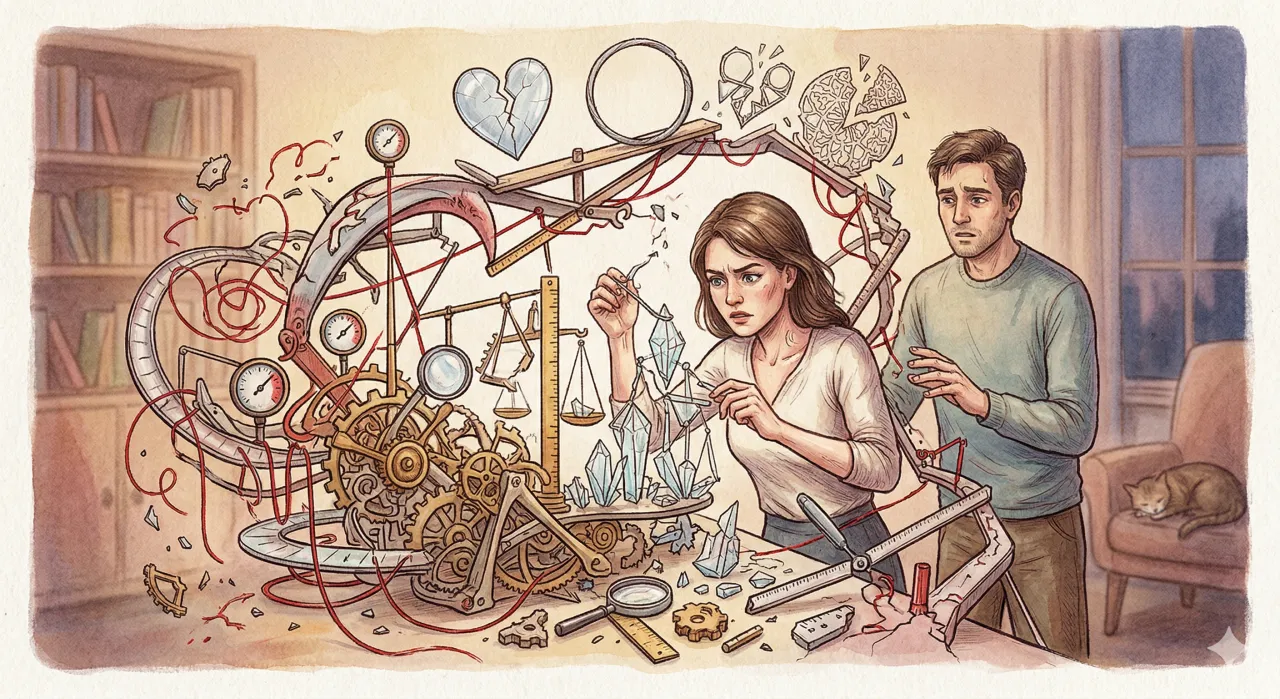
A story I heard during lunch stayed with me. In March 2024, a coworker was talking about dating and said, “I’m just trying to do it well, but I think my partner feels like I’m always evaluating them.”
That coworker was extremely meticulous at work. They were rarely late, and their plans almost never went off track. But in dating, that strength kept coming back as fatigue. If a date route went slightly differently than planned, if their partner misspoke, or if the day did not unfold exactly as expected, the discomfort lingered for a long time.
They had set standards because they wanted to build a better relationship, but inside those standards, their partner always ended up feeling like the inadequate one. Listening to that story made me realize that perfectionism does not always work in a good direction in love.
“My partner treats me well, but something always feels lacking.” When I listen to dating concerns, some people say this. Their partner is not a bad person. They text, they go on dates, they remember anniversaries, and they have not done anything seriously wrong. Still, for some reason, the relationship does not feel comfortable. The date spot was slightly disappointing. Their tone was not as warm as expected. The gift was appreciated, but it did not feel like they had perfectly understood my taste. The birthday event was clearly prepared, but somehow it looked a little clumsy. Outwardly, I might say, “Thank you,” but inside, thoughts like these come up. “Couldn’t they have paid just a little more attention?” “This isn’t the feeling I expected.” “If they really knew me, they wouldn’t have done it this way.” “Am I being too sensitive for not being satisfied with this?” In the past, when I heard these concerns, I simply thought the person had high standards. But after hearing many relationship stories, I realized it is not always that simple. Some people become more sensitive not because they want to torment their partner, but because they truly want to do the relationship well. Some people feel even small mismatches strongly because they want to be loved deeply. Some people are so strict with themselves that they stay tense even inside a romantic relationship. The problem begins when those high standards do not make the relationship better, but instead make it exhausting. Perfectionism can create results at work or in study. It makes people plan, reduce mistakes, and work toward better outcomes. But dating is different. Dating is about one person meeting another person. People are not always consistent, emotions do not move according to plan, and relationships do not get neatly organized every time. That is why dating often becomes tiring for people with strong perfectionistic tendencies. Their partners get tired, but in truth, they themselves become exhausted too. This article is not meant to criticize perfectionists. It is for people who want to do love well but keep feeling tired, who notice the lacking parts first even when their partner treats them well, and who feel the whole relationship shake over small conflicts. It is an invitation to look at what standards are operating inside them.
The Person Who Prepares the Perfect Date but Cannot Actually Enjoy It
I had a friend who prepared dates with incredible effort. When choosing a restaurant, they read dozens of reviews. When planning a route, they calculated travel time. They checked the atmosphere of cafés and whether parking was available. For anniversaries, they prepared gifts, letters, restaurant reservations, and even photo spots almost like a project. At first, I thought it was amazing. It is not easy to care that much for someone. But one day that friend said this. “After a date, I should feel happy, but I keep feeling like I’m looking at an evaluation sheet.” When I asked what they meant, they explained. If the restaurant food was worse than expected, the whole day felt disappointing. If the reserved café was noisier than expected, they felt as if they had failed. If their partner’s expression did not look as pleased as they had hoped, it felt as if all the preparation for the day had collapsed. Their partner said, “Thank you, I had fun.” But my friend could not quite believe it. “Did they really have fun?” “Should I have prepared better?” “Next time, I need to make it more perfect.” Those thoughts kept continuing. That was when I realized that perfectionism is not only strict toward the other person. It can also appear as a way of constantly pushing oneself. Wanting to be good at love is a good thing. Wanting to make your partner happy is also a good thing. But if what remains after a date is self-evaluation rather than joy, the relationship becomes more like an assignment than a relationship. Dating is not about creating a polished event every time. Sometimes the plan goes wrong, the restaurant is mediocre, or rain changes the schedule. In many cases, being able to laugh together inside those imperfect moments matters more. When perfectionism is strong, people hold onto what was lacking longer than they hold onto the good moments. Instead of “I’m glad we were together,” the first thought becomes, “Why couldn’t I make a better choice back then?” When that happens, love stops being a place to rest and becomes a place where you must keep performing well.
When You Only See the Missing 10% Even Though Your Partner Tried
The moment perfectionism works most painfully in dating is when your partner clearly did something for you, but your heart still does not feel settled. Think about a birthday, for example. Your partner bought a cake, booked a restaurant, and prepared a small gift. Objectively, it is something to be thankful for. But in one corner of your mind, thoughts like these rise up. “It’s not the brand I like.” “The letter is a little short.” “The restaurant atmosphere is nice, but the food is worse than I expected.” “Did they put in less effort than last year?” “If they remembered what I said, would they have chosen this?” Having these thoughts does not make someone a bad person. Everyone has expectations, and it is natural to feel disappointed when expectations are not met. The problem is when that disappointment covers the entire experience. Someone around me once said this. “I’m clearly grateful, but I’m also disappointed at the same time. That makes me feel like such a terrible person.” I thought this sentence captured the fatigue of perfectionistic love very well. Perfectionists do see their partner’s effort, but they also see the lacking parts with painful clarity. And they often cannot let those lacking parts remain as small disappointments. “If they really loved me, they would have done better.” “Shouldn’t they have known my taste exactly?” “If they couldn’t meet my expectations, doesn’t that mean their feelings are only that strong?” The interpretation grows larger. But in dating, love does not always appear as a perfect result. A partner may love you and still be bad at choosing gifts. They may care about you and still prepare an awkward event. They may be sincere and still express themselves in a way that differs from what you expected. When perfectionism is strong, it is hard to tolerate this difference. Rather than asking whether love exists, you start looking more at whether love was expressed in the way you imagined. At those moments, it can help to change the question. Instead of “Did my partner do it perfectly?” ask, “Did my partner try to think of me?” This question lets you see the relationship a little differently. The expression may not have been perfect, but was there heart in it? It may have differed from your expectations, but was there effort? The result may have been lacking, but was there an attitude of valuing the relationship? If you cannot see this, many warm moments inside the relationship remain only as “insufficient results.”
Perfectionists Make Checklists Even in Love
For some people, perfectionism works strongly when choosing a partner. When I listen to stories about blind dates or introductions, I sometimes hear cases like this. The person’s job should be good, their appearance should be my type, conversation should flow well, financial values should match, family relationships should be stable, hobbies should not be too different, texting style should fit, and even the sense of humor should match. Of course, having standards matters. This is not about dating just anyone. But when the standards become too numerous, meeting a person starts to feel less like getting to know someone and more like reviewing a list of conditions. One acquaintance always evaluated dates in great detail afterward. “We communicate well, but their clothing style is a bit disappointing.” “Their job is fine, but our humor doesn’t match.” “Their appearance is okay, but their family atmosphere bothers me a little.” “They’re not bad, but I don’t feel a strong pull.” “I feel like there could be someone better.” At first, I thought they were just cautious. But even as time passed, no relationship began. Even when good qualities were visible, one small disappointment blocked their heart. Eventually, that acquaintance said something I still remember. “I feel like I’m not looking at people. I’m looking for reasons to eliminate them.” That seems to be the core of perfectionistic choice. Perfectionists want to find a good person, but at the same time, they do not want to make a mistake. They are afraid of regretting the choice later, missing someone better, or choosing someone inadequate. So instead of fully experiencing the person in front of them, they keep comparing and reviewing. “Is this person right?” “Could there be someone who fits me better?” “Could this flaw become a big problem later?” “Am I compromising too much?” Caution is necessary. But excessive perfectionism makes a relationship exhausting before it even begins. Standards for choosing a good partner are needed, but the standard of finding a perfect person has no end. Everyone has strengths and weaknesses together. What matters is not finding someone with no flaws, but seeing whether their flaws are ones you can live with and whether they are someone you can adjust with.
When Small Conflict Feels Like the Failure of the Entire Relationship
People with strong perfectionistic tendencies often find conflict especially difficult. When conflict happens, they do not simply feel, “We have a difference of opinion.” Instead, they feel as if the entire relationship has a problem. “Are we really right for each other?” “If we fight over something like this, maybe this relationship isn’t right.” “Shouldn’t a good relationship avoid clashing this much?” “Should I have met someone who fit me better from the beginning?” These thoughts rise quickly. I had a friend like this. They had not even had a huge fight with their partner. It was a disagreement about date scheduling, and because both were tired, their tones became slightly sharp. But that night, my friend thought almost all the way to breaking up. “If we’re this incompatible, can we really think about marriage?” “If this were a good relationship, we wouldn’t fight about something like this.” “Did I choose wrong?” From the outside, it looked like a problem that could be solved through conversation. But to my friend, the conflict felt like a crack in the whole relationship. Perfectionists tend to divide relationships quickly into “good relationships” and “problematic relationships.” If we fit well, it is a good relationship. If we fight, it is a problematic relationship. If my partner meets my expectations, I am loved. If they differ from my expectations, the relationship is shaken. But real relationships are not that neat. Good relationships also have fights. People who fit well also misunderstand each other. Even a loving person can sound cold when tired. What matters is not that conflict never happens, but whether the relationship can recover afterward. A perfect relationship is not a relationship without conflict. It is a relationship where, when conflict happens, the two people can talk again without destroying each other. The questions a perfectionistic person needs are these. “Is this conflict really about the whole relationship?” “Or is it one situation we need to adjust right now?” “Am I looking at the problem, or am I looking at failure?” Without these questions, every small conflict feels like a final evaluation of the relationship.
Perfectionism Directed at Your Partner Exhausts a Relationship Fastest
Perfectionism has different directions. Some people are strict with themselves, and some are strict with their partner. In dating, the especially dangerous case is demanding perfection from the other person. “If they are my partner, they should naturally know this much.” “Shouldn’t they notice even if I don’t say it?” “Why can’t they even take care of this?” “I do this much for you, so why can’t you?” If you often have these thoughts, it may be worth looking back. Of course, basic consideration is necessary in a relationship. If a partner is consistently careless, breaks promises, or ignores your feelings, that is a problem. But if even the fact that your partner expresses love differently from you is seen only as “lack,” the relationship becomes difficult. One friend was very hurt because their partner did not prepare a big birthday event. But that partner usually picked them up, bought medicine when they were sick, and made time even when busy. My friend said this. “I know they’re good to me in everyday life, but special days should feel special.” I understood that too. For someone who values anniversaries, that could be genuinely disappointing. But from the outside, the partner did not seem like someone without love. Their expression style was simply different. My friend wanted to feel loved through events and words, while their partner tended to care through everyday actions. When perfectionism is strong in this kind of situation, the partner’s way of expressing love becomes hard to see, and only the fact that it is not the way you expected becomes visible. It starts to feel like “if they do not love me in the way I want, it is insufficient love.” What matters in a relationship is not turning your partner into the perfect lover who fits your standards. It is learning how each of you expresses love differently and talking through what you need. Instead of “Why are you so bad at this?” it is much better to say, “I feel especially loved when I receive some expression on special days. Next time, I’d like us to mark it in even a small way.” When you demand perfection, your partner feels like they are constantly being tested. When you state your needs concretely, your partner can learn.
Perfectionism Directed at Yourself Also Makes Love Exhausting
People who are strict with their partners are not the only ones who struggle. People who are excessively strict with themselves also become very tired in relationships. “I should be a better partner.” “I should understand more.” “I shouldn’t feel hurt.” “I shouldn’t feel jealous.” “I shouldn’t burden my partner.” “I should always speak maturely.” With these standards, love is not comfortable. From the outside, such a person may look like a good partner. They are considerate, patient, careful with words, and try not to burden the other person. But internally, they are constantly censoring themselves. “Was I too sensitive?” “Should I have endured more?” “Did I ruin the mood?” “Why can’t I be more cool about this?” One friend always self-checked before saying they were hurt by something their partner did. “Is this an acceptable thing to feel hurt about?” “Am I asking for too much?” “Am I burdening them when they are already tired?” In the end, they often said nothing and let it pass. Then they became exhausted alone. The desire to be a perfect partner can look admirable, but inside it there is often fear. Fear that if I am lacking, I will not be loved. Fear that if I make a mistake, the relationship will break. Fear that if I show my emotions, the other person will feel burdened. But what dating requires is not a perfect attitude. It is honesty and the ability to recover. You can feel hurt. You can feel jealous. You can become sensitive when tired. You can say something badly. What matters is not collapsing into “I’m the worst” when such moments come, but talking again and adjusting. A good partner is not someone who never makes mistakes. A good partner is someone who can acknowledge mistakes, try to see the other person’s heart, and keep adjusting.
The Perfect Couple Image on Social Media Makes Dating Harder
These days, it is easy to compare relationships too. On social media, everyone goes to pretty cafés, receives bouquets on anniversaries, travels as a couple, and leaves beautiful photos. Other people’s relationships always appear as highlights. The problem is that we compare those highlights with our ordinary daily life. “That couple is so affectionate. Why are we so plain?” “That person does that much for anniversaries. Why doesn’t my partner?” “Other couples travel often. Are we too boring?” “Is our relationship lacking something?” I have heard many stories like this. People with perfectionistic tendencies especially tend to use the relationship images on social media as standards. Sometimes they care more about whether the relationship looks good to others than what the relationship is actually like. One acquaintance cared first about whether the photos would turn out well when going on a date. Even after eating good food and spending a nice time together, if the photos were not satisfying, the entire date felt disappointing. Later, their partner reportedly said this. “I don’t know whether I’m spending time with you or shooting content.” That sentence stayed with me for a long time. It is natural to want to record a relationship beautifully. But when a relationship for display starts to come before the real relationship, it becomes exhausting. A good relationship is not always a relationship that looks pretty in photos. Sometimes it can be a relationship where you wear comfortable clothes, walk around the neighborhood, eat without much planning, and feel fine even when you sit quietly and rest separately. The couple image on social media is not the whole relationship. What people post is usually the well-captured moment. The fight, the tired face, the money problem, the hurt feelings, and the awkward reconciliation are rarely uploaded. If you have perfectionistic tendencies, it helps to remember this when you look at social media. “Am I comparing someone else’s highlight with my reality right now?” Love is not something you do for display. What matters more is whether the two of you actually feel comfortable.
Healthy High Standards and Relationship-Damaging Perfectionism Are Different
There is an important point here. Saying we should loosen perfectionism does not mean we should date with no standards at all. Standards are necessary in relationships. Wanting someone who does not treat you carelessly, someone responsible, someone basically considerate, and someone capable of conversation is completely natural. The problem is not the standard itself, but the reaction when the standard is not met. Healthy standards are needed to protect yourself. But unhealthy perfectionism keeps evaluating and pushing both the other person and yourself. The difference appears in places like these. A healthy standard says, “I need this kind of relationship.” Perfectionism says, “My partner should naturally be like this.” A healthy standard allows adjustment. Perfectionism sees even a small mismatch as failure. A healthy standard sees the other person’s effort. Perfectionism sees the insufficient result. A healthy standard protects me. Perfectionism exhausts both me and my partner. For example, think about texting. “I feel comfortable in a relationship where we check in with each other about once a day.” This can be a healthy standard. But “If they love me, they should always contact me at the right timing without me saying anything” is closer to perfectionism. Anniversaries are similar. “I value anniversaries, so I’d like us to mark them even in a small way.” This is an expressible need. But “If they don’t prepare it perfectly in the way I want, their love is lacking” turns the relationship into a test. What dating needs is not perfect standards, but standards that both people can understand.
Practices to Try If You Have Strong Perfectionistic Tendencies
Perfectionistic tendencies do not disappear overnight. They are familiar patterns built over a long time. For someone who has learned that they must do well to be loved, must not make mistakes, and that inadequacy creates problems, the advice “just relax” may not help much. That is why small practices are more realistic than grand changes.
1. Look first at the 80% that was enough, not the lacking 20%
When your partner does something for you, disappointing parts may be visible. You do not need to forcibly erase them. But before speaking about the disappointment, it can help to practice seeing what was enough first. “It wasn’t perfect, but they did prepare it while thinking of me.” “It differed from my expectations, but there was effort.” “There are lacking parts, but there are also things I am grateful for.” Seeing it this way can make the relationship feel a little less cold.
2. See conflict as adjustment, not failure
A fight does not mean the relationship has failed. Conflict is a signal that two people are different. The problem is not the conflict itself, but how the conflict is handled. Before going straight to “We are not compatible,” you can ask: “What are we feeling differently about right now?” “Is this a problem we can adjust?” “Am I evaluating the whole relationship too quickly?” These questions help prevent small conflicts from becoming huge crises.
3. Say concretely what you want from your partner
Perfectionists often expect the other person to know without being told. But your partner does not know the standard sheet inside your head. Instead of “How could you not know this?” it is better to say, “I feel loved when you express it in this kind of way.” The fact that your partner did not meet your expectation does not necessarily mean there is no love. The expectation may simply not have been shared.
4. Do not punish yourself for too long after making a mistake
Perfectionists blame themselves for a long time when they make mistakes in relationships. Speaking a little harshly. Expressing hurt awkwardly. Not doing as well as expected. They push themselves hard over these moments. But relationships are not made by perfect people. They are processes in which imperfect people learn from each other. It is necessary to practice changing “I ruined it again” into “How can I say this differently next time?”
5. Look at whether the relationship is actually comfortable, not whether it looks good
More important than having many moments worth posting on social media is whether you actually feel comfortable. Do you feel like you must keep doing well when you are with your partner? Can you recover through conversation even when you make a mistake? Can you laugh together when plans go wrong? Was it a good time even without photos? These things are closer to real relationship satisfaction.
MATE Test Can Help You See Where Perfectionism Operates
Having perfectionistic tendencies does not mean everyone dates in the same way. For some people, perfectionism appears strongly in the operating style. They feel comfortable when plans, schedules, money, and role divisions are organized. For others, perfectionism appears in conflict handling. They think a good relationship is one without fights, and even a small argument makes them very anxious. For some, it appears in closeness. They think that if two people love each other, they should always express it with the same temperature, and they interpret the other person’s distance as a problem in the relationship. For others, it appears in daily rhythm. They feel uncomfortable when the frequency of dates, texting times, and the way weekends are spent move outside the frame they expected. The MATE test can be used as a starting point to look at these differences. Am I someone who feels comfortable with structured operation? Does my partner want a more flexible style? Do I experience conflict as a crisis in the relationship, while my partner sees it as a natural process of adjustment? When you understand these differences, you can stop seeing perfectionism as “my personality is strange” and instead understand it as “this is how I try to feel secure in relationships.” The test does not decide the answer. But it can turn vague discomfort into language that can be discussed.
In These Cases, You Should Look at the Relationship Itself, Not Perfectionism
There is one thing that must be distinguished. Just because you have perfectionistic tendencies does not mean every complaint is your problem. If your partner repeatedly breaks promises, ignores your emotions, avoids responsibility, hurts you with words, or keeps avoiding important issues, it may not simply be that your standards are too high. Letting go of perfectionism does not mean accepting someone who treats you carelessly. Healthy standards are necessary. The desire to be respected. The desire for an honest relationship. The expectation of basic responsibility. The desire to meet someone who can communicate. These standards are closer to self-protection than perfectionism. So you need to ask yourself: “Am I asking for unrealistic perfection right now?” “Or am I asking for the basic respect needed in a relationship?” It is important to distinguish the two. Letting go of perfectionism does not mean enduring just any relationship. It means separating the standards that truly matter from the standards you may be able to release.
Closing: A Good-Enough Relationship Lasts Longer Than a Perfect One
Wanting to do love well is a good desire. Wanting to treat your partner well, build a good relationship, avoid mistakes, and stay stable for a long time are precious desires. But when that desire becomes an excessively high standard, the relationship becomes tiring. Even when your partner treats you well, the lacking parts appear first. Small conflicts feel like the failure of the entire relationship. You push yourself to become a perfect partner. You keep comparing your relationship with the couple images on social media. You imagine someone more perfect than the person you are currently dating. When that happens, love becomes closer to evaluation than comfort. There is no perfect relationship. There is no perfect person. There is hardly ever a perfect timing, perfect expression, perfect date, or perfect reconciliation. But good-enough relationships do exist. A relationship where both people try despite shortcomings. A relationship where expectations can be adjusted through words. A relationship that can recover after mistakes. A relationship that is actually comfortable for the two people, not just good-looking to others. A relationship where both people value each other even if it is not perfect. If you have strong perfectionism, I hope you remember this in love. Love is not an exam paper. Your partner is not there to be graded. You are not someone who must be a perfect partner in order to be loved. Dating is not about finding the perfect answer. It is closer to a process in which two imperfect people learn each other’s ways. Just because your current relationship is not perfect does not necessarily mean it is wrong. What matters is whether both of you are willing to adjust together, whether you can let go of standards that exhaust each other, and whether you can see the good-enough moments. What lasts longer than a perfect relationship is a good-enough relationship.
You might also enjoy:
- Why Low Self-Esteem Can Make Dating So Hard
- Why My “Ideal Type” Was Different From the Person I Actually Liked
Frequently Asked Questions
Q. If I have strong perfectionistic tendencies, is it better not to date? No. Having perfectionistic tendencies does not mean you should not date. What matters is noticing what standards you are applying to the relationship. If you check whether you are placing unrealistic expectations on your partner, seeing small conflicts as the failure of the whole relationship, or pushing yourself to become a perfect partner, the relationship can change.
Q. How are high standards different from perfectionism?
High standards can be standards that protect you. Wanting respect, honesty, responsibility, and the ability to communicate are healthy standards. Perfectionism, on the other hand, makes you reject the entire relationship when the standard is missed even slightly, keeps you evaluating your partner, and makes you criticize yourself harshly. The key difference is your reaction when the standard is not met.
Q. What should I do if my partner is a perfectionist and it is too hard for me? If you only keep trying to match everything, you can become exhausted. Rather than trying to satisfy all of your partner’s expectations, you need to honestly talk about the pressure you feel. “I know you want to build a good relationship, but sometimes I feel like I’m constantly being evaluated.” “I will try too, but I am not someone who can match everything perfectly.” It is necessary to set boundaries gently in this way.
Q. I feel like perfectionism makes my relationship shake over small things. What should I do? When a small conflict happens, practice not jumping straight to the conclusion, “We are not compatible.” Try seeing conflict not as failure, but as a point to adjust. “Is this a problem with the entire relationship, or one problem to solve right now?” “Is this proof that my partner does not love me, or simply a difference in expression style?” Changing the question this way can calm the emotion a little.
Q. If I let go of perfectionism, won’t my standards become too low? No. Letting go of perfectionism does not mean dating without standards. It means distinguishing between standards that truly matter and standards you can release. Respect, responsibility, honesty, and the ability to communicate are important standards. But the belief that every expression must match your expectations exactly or that there should be no small mistakes can exhaust a relationship.