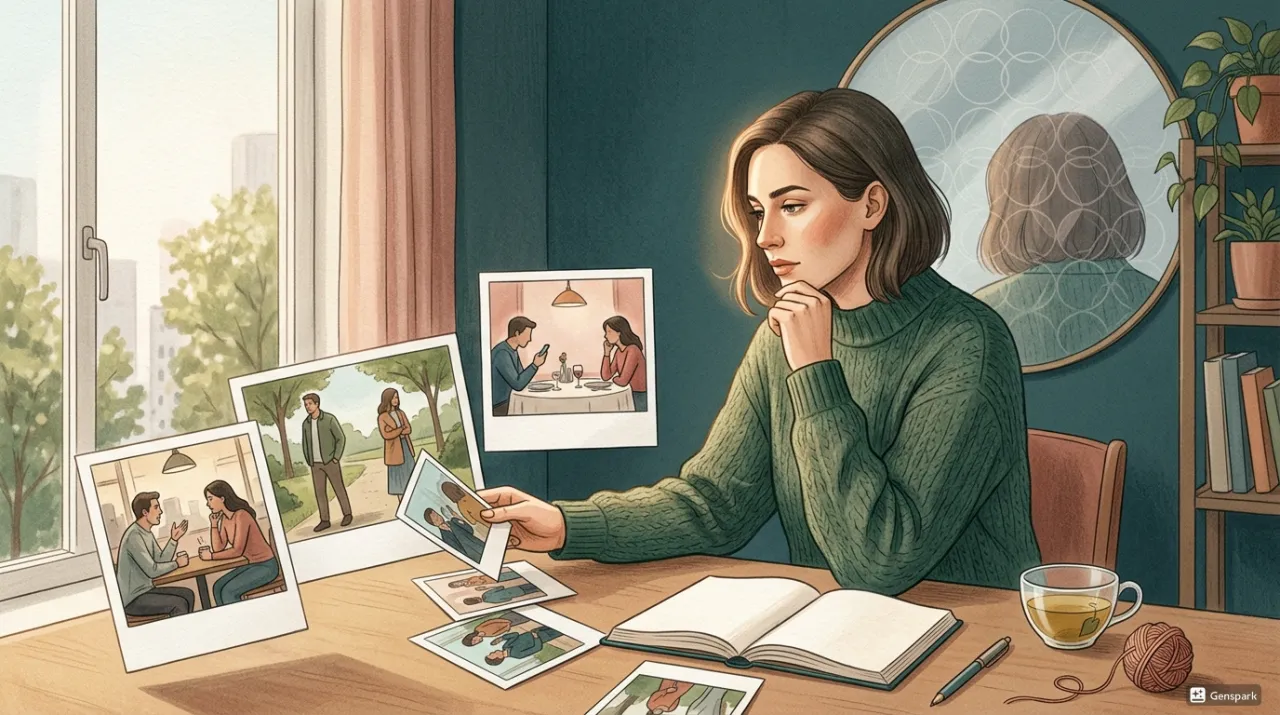
In early 2024, I was having drinks with an old friend when the question came up: “Why do I always end up dating similar people?” My friend had struggled with communication in one relationship, and then felt exhausted for almost the same reason in the next one. The person was different, but strangely, the ending felt similar.
At first, we thought it was just bad luck. But as we talked longer, it became clear that the repeated part was not only the partners. My friend always tried hard to adjust to the other person in the beginning, did not say it right away when something hurt, and only exploded after holding it in for a long time.
Even when the partner changed, the way my friend reacted stayed similar, so the flow of the relationship became similar too. After that conversation, I started thinking that relationship patterns should not stop at the question, “Why do I only meet people like this?”
“Why do you always date people who are busy?”
I heard that sentence on a Friday night in April 2023.
The place was a small izakaya near Sinnonhyeon Station. I was drinking with a close friend for the first time in a while, and I was talking about a relationship that had just ended.
I said, feeling quite wronged,
“This one ended the same way too. At first they clearly treated me well, but over time the replies got slower, and when I said I felt hurt, they said I was being burdensome. In the end, I became the one who looked clingy.”
My friend listened for a while and then quietly said,
“But didn’t you say almost the same thing last time?”
I immediately denied it.
“No. This person was different.”
My friend did not laugh. They just said,
“The person was different, but the points that hurt you were almost the same. Waiting for replies, trying to understand when they said they were busy, not saying you were hurt, and then exploding all at once.”
When I heard that, I put my glass down.
At first, I did not feel good. It sounded like my friend was saying I was the problem.
But on my way home, that sentence kept coming back to me.
“The person was different, but the points that hurt you were the same.”
That night, when I got home, I thought back on my past relationships.
The person I met in the winter of 2021. The relationship that ended in the spring of 2022. The similar breakup that repeated again in early 2023.
Their jobs, personalities, and ways of speaking were different. But the way I became anxious and exhausted was strangely similar.
At first, the person was busy. I tried to understand that busyness. When replies were late, I thought, “They must have a lot of work.” Then hurt began to build up, and I held it in because I was afraid of becoming a burden. Eventually my emotions burst, and the other person said, “Why are you suddenly like this?” I got hurt alone, and the relationship slowly grew distant.
That was the first time I asked myself:
“Was I really just unlucky to meet people like this?”
“Or was I repeatedly choosing similar kinds of relationships?”
This is not a piece meant to say, “You are the problem,” to people whose relationships keep failing. It is rather a piece for people like me, who keep suffering for similar reasons, to understand that repetition a little more gently.
Understanding a relationship pattern is not self-blame. It is looking at why I was drawn to certain people, why I reacted in certain ways, and why I kept breaking down at the same point.
And strangely, simply noticing that can begin to change the relationship.
In the winter of 2021, I was drawn to another “busy person”
The first person who comes clearly to mind is someone I met in December 2021.
It was the end of the year, and I met them through a friend. The place was a small wine bar near Euljiro 1-ga Station. It was eight o’clock on a Friday evening, and the street was lit with Christmas lights.
They arrived ten minutes late.
“Sorry. My meeting ran long.”
That was the first thing they said.
I smiled and answered,
“It’s okay. I just got here too.”
Actually, I had not just arrived. I had been there for fifteen minutes, reading the menu twice. But it felt awkward to say I had already been waiting on a first meeting, so I said it was okay.
They spoke quickly, and their eyes lit up when they talked about work. They had many projects, a large role at the company, and seemed ambitious about what they did.
I thought that was attractive.
“They still made time even though they’re busy.”
“Someone who works hard is attractive.”
“If they are that immersed in work, they must be responsible too.”
At the time, I did not know why I was so drawn to busy people.
The first few weeks were good. They made time despite being busy, and that time felt even more special to me.
Even a short phone call at ten on a weekday night made me happy. Even meeting for only two or three hours on the weekend made me grateful. When they said, “This week was crazy, but I still wanted to see you,” my heart softened.
But as time passed, the same scenes repeated.
Plans were often postponed. Replies became slow. Even during calls, they checked work messages. Even when we met, they looked tired.
At first, I tried to understand.
“They must be in a busy season.”
“I know what working life is like.”
“It probably doesn’t mean they dislike me.”
I tried to think that way.
But my heart gradually grew anxious.
If a KakaoTalk reply was three hours late, I kept checking my phone. When they said, “Today is too hectic,” I answered that it was okay, but inside I felt hurt. If a weekend plan was canceled, I said, “It’s okay, rest,” but my mood sank at night.
The sentence I said most often then was this:
“It’s okay.”
It was not okay, but I said it was.
Because I was afraid that if I said I was hurt, I would look like someone without understanding.
That relationship ended around March 2022.
During the breakup, the other person said,
“I think you are becoming a little burdensome to me.”
I broke down when I heard that.
I had held myself back so much because I did not want to be a burden, but in the end I had become burdensome anyway.
At the time, I thought the relationship had become hard because the other person was too busy. But later, I realized that their busyness was not the only problem.
I was drawn to a busy person, became anxious inside that busyness, pretended to be okay even when I was not, and eventually collapsed all at once. That was the pattern I was repeating.
In the spring of 2022, I thought this time would be different
In May 2022, I met someone else.
This time, I really thought it would be different.
They were not the kind of person who was completely absorbed in work like the previous person. Their tone was gentle, and in the beginning, they replied fairly well. We first met at a cafe near Gangnam Station, and the conversation flowed well from the start.
I remember something they said that day.
“For me, comfort is the most important thing in a relationship. I like meeting naturally without putting too much pressure on each other.”
I liked hearing that.
Because I had felt so anxious in the previous relationship, the phrase “a comfortable relationship” sounded reassuring.
But later, I realized that what I meant by comfort and what they meant by comfort were a little different.
For me, a comfortable relationship meant one where we could speak honestly. For them, a comfortable relationship was closer to one where we did not have to talk too much about emotions.
I did not know that at first.
We met often. We went to the Han River on weekends, visited cafes in Seongsu-dong, and once watched a movie at COEX on a rainy day.
But whenever the relationship began to get a little deeper, they seemed to take one step back.
When I asked, “What are we becoming?” they said, “Isn’t it enough that things are good right now?”
When I said, “I felt a little hurt because it seems like your replies have decreased lately,” they said, “I’m just not the type to message a lot.”
When I brought up my feelings, they seemed like someone trying to close the conversation.
At first, I tried to understand again.
“Everyone has a different style.”
“Maybe I just want too much reassurance.”
“This time, I should not act anxious like before.”
But strangely, the same version of myself appeared again.
I waited for replies, interpreted their tone, built up hurt alone, and held it in because I was afraid the relationship would become distant if I spoke.
Then one day, I burst.
It was a Sunday night in August 2022. I was at home looking at KakaoTalk, and I ended up sending a long message.
“Lately, I feel like you don’t think I’m very important. You say things are comfortable, but I feel like I’m the only one trying.”
They replied after a long while.
“I don’t really understand why you feel that way. I was just doing things my way.”
When I saw that reply, my heart went cold.
I barely slept that night.
And I thought the same thing again.
“Why do I always end up in relationships like this?”
I had thought this person was completely different from the previous one. But the emotions I felt were surprisingly similar.
Waiting. Anxiety. Holding back. Exploding. And the other person’s distance.
From then on, I began to suspect something.
Maybe I was habitually drawn to people who were slow to express emotions, people who kept a certain distance.
In April 2023, my friend saw my pattern before I did
I faced this question properly in April 2023.
It was the night I was telling my friend about my breakup at the izakaya near Sinnonhyeon Station. I was talking about the other person again.
“At first, they really did treat me well. But later, I felt like I was always the one checking. I just wanted to feel secure, but they said I was burdensome.”
My friend was silent for a moment and then said,
“You always seem to be drawn to people who are slow to express emotions.”
I immediately denied it.
“No. This person expressed a lot in the beginning.”
My friend said,
“Not in the beginning. When the relationship starts to deepen. Every time, the other person takes one step back, and you move closer. Then you get exhausted.”
The sentence was so accurate that it annoyed me.
I held my glass and stayed silent for a while.
My friend continued.
“You describe them as ‘calm’ at first, but later they often turn out to be people who are slow with emotional expression. And when that person does not give you certainty, you end up clinging harder.”
That night, when I got home, I took out a notebook.
I was not someone who kept a diary consistently, but that night I felt like I had to write something down.
At the top of the page, I wrote:
“Common traits of the people I repeatedly date.”
Then I listed them one by one.
Busy people. People slow to express emotion. People who do not clearly define the pace of the relationship. People who feel burdened when I say I am hurt. People who are affectionate at first but create distance as things deepen.
Then I wrote down my reactions.
At first, I understand. I say it is okay even when I am hurt. I wait for replies. I analyze their tone. I become anxious alone. I hold it in and then send a long message. When the other person feels burdened, I get even more hurt.
Seeing it written down surprised me.
Even when the other person changed, my pattern was almost the same.
That day was the first time I admitted it.
My relationships had not repeated simply because I was unlucky with partners. There were types of people I was habitually drawn to, and there were reactions I automatically repeated inside relationships.
Writing it down made me feel strange.
I felt embarrassed, wronged, and also a little relieved.
“Oh, I am not just strange. There is a pattern.”
Just realizing that changed something a little.
Why was I more drawn to people with distance?
After writing down my relationship patterns, the hardest part to understand was this.
I clearly wanted a stable relationship. Then why did I keep being drawn to people who had distance?
In my head, I said I liked warm and steady people. But in reality, I reacted more strongly to people who were busy, slow to express emotions, and vague about defining the relationship.
It felt so strange.
Then one day, this thought suddenly came to me:
“Maybe I had mistaken familiarity for stability, or even for love.”
People whose feelings did not come clearly. People whose affection felt a little lacking. People I had to try harder to get close to. People who made me keep checking whether they had chosen me.
Those relationships made me anxious, but they were also strangely familiar.
When the other person moved away a little, I tried harder. When they expressed less, I tried to become better. When they were vague, I wanted to become more certain.
There was even a strange sense of achievement in that process.
“If this person chooses me, it feels like I become someone worthy of love.”
Looking back now, that is a dangerous feeling.
Love is not a test where you keep having to be proven by the other person. But unconsciously, I was repeating relationships that felt like that.
On the other hand, when I met someone who expressed themselves steadily from the start, I strangely did not feel a strong pull.
There was once someone who approached me in a very stable way. They kept promises well, replied consistently, and expressed their feelings clearly.
But I felt, “There is not enough spark.”
Looking back now, maybe it was not that the person lacked spark. Maybe they lacked the anxiety I was used to.
I had felt a relationship without anxiety was dull.
Realizing that was a bit shocking.
I thought I was looking for love, but maybe I was repeating a familiar tension.
Before I understood my pattern, everything looked like the other person’s fault
Before I understood my pattern, I often blamed the other person whenever a relationship ended.
“They were too busy.”
“They did not express themselves.”
“They avoided conversations.”
“They made me anxious.”
Of course, the other person also had responsibility. A relationship is not made by one person alone.
But when the same thing repeats, it is necessary to look at my own reactions too.
Why was I drawn even after seeing vague signals early on? Why could I not say I was hurt in the beginning? Why did I become more anxious and move closer whenever the other person created distance? Why did I feel less moved when I met someone stable?
Before I asked these questions, the endings were always similar.
I blamed the other person, recovered over time, met someone similar again, and suffered in a similar way again.
But after writing down my pattern, something changed.
When I felt drawn to someone, I stopped immediately thinking, “Is this person destiny?” and began asking first:
“What exactly am I drawn to in this person?”
“Is this attraction comfort, or anxiety?”
“Am I trying to get certainty from an ambiguous person again?”
“Do I become more myself with this person, or more anxious?”
Just asking these questions changed how I looked at relationships.
When you know your pattern, you blame the other person less. That does not mean you start blaming yourself instead.
You begin to see the structure of the relationship.
“Oh, in this kind of situation, I react this way.”
“I become especially shaken by this kind of person.”
“This is the point where I always lose myself.”
When understanding appears, a little room for choice appears too.
Before, I reacted automatically. Now, I can pause for a moment.
Writing a relationship journal helped me see my repetition for the first time
What actually helped me the most was a relationship journal.
It was not anything grand, like therapy notes. I simply bought one notebook and organized my past relationships.
It was a Sunday afternoon in May 2023. I was at a quiet cafe in Mangwon-dong. I sat by the window, ordered an iced Americano, and opened my notebook.
At first, I felt embarrassed.
Writing down past relationships felt strange, as if I were dragging people from the past back out.
Still, I wrote.
The first person.
Where I met them. What first attracted me to them. What conflicts repeated in the relationship. What emotion I felt most often. What words I heard during the breakup.
I wrote about the second person too. Then the third.
As I wrote, common patterns began to appear.
I always saw “immersion in their work” as attractive at first. But over time, that same immersion turned into the feeling, “I am being pushed to the side.”
I first felt the other person’s “coolness” as comfort. But over time, that coolness began to feel like “emotional avoidance.”
At first, I tended to adjust to the other person. But later, the thought “Why am I the only one adjusting?” would explode inside me.
The most shocking part was that I wrote almost the same sentences every time.
“I felt like I was trying alone.”
“The other person felt I had suddenly become sensitive.”
“I said ‘it’s okay’ too much in the beginning.”
I stared blankly at those sentences for a while.
I had thought I was in a different relationship every time. But the script repeating inside me was almost the same.
Through the relationship journal, I learned this:
Patterns become much clearer when you write them down than when you only think about them.
In your head, it is easy to think, “This time was different.” But when you put things on paper, similar sentences appear.
After that, even when I met someone new, I sometimes wrote things down.
“What is the reason I am drawn to this person?”
“Is the feeling this person gives me stability, or tension?”
“Am I saying what I need, or am I saying it is okay again?”
Those questions held me in place quite a lot.
Knowing the pattern did not mean I changed immediately
One important thing is that noticing a pattern did not instantly make me a different person.
It was the same for me.
Even after I learned that I had a pattern of being drawn to ambiguous people, when a similar person appeared, my heart still shook.
I was still strangely drawn to people who replied slowly, were busy with their own work, and expressed emotions sparingly.
But one thing was different.
Before, I followed that pull exactly as it came. Now, I paused for a moment and looked at it.
“Am I being drawn to a familiar anxiety right now?”
“Do I feel comfortable with this person, or do I keep wanting to look good?”
“Am I disguising the other person’s ambiguity as charm again?”
Just being able to ask those questions made things different.
In the past, if the other person did not reply all day, I would have become anxious alone and sent a long message at night.
But one day, I stopped.
I picked up my phone, wrote a message, and deleted it.
“I am anxious right now and want reassurance.”
Once I noticed that, I did not have to act immediately. Instead, the next day, I said it a little more calmly.
“I am the kind of person who feels a little anxious if there is no contact all day. I am not saying we need to message at length all the time, but if you are busy, even a short note would help me.”
That sentence was different from my old long messages.
I did not corner the other person, but I did not hide my feelings either.
Whether the other person could accept that request was another matter. But at least I did not repeat my pattern of holding back and then exploding.
Knowing a pattern does not mean changing perfectly.
It means a small gap appears between automatic reaction and action.
Inside that gap, we can choose differently.
Three relationship patterns I kept repeating
As I wrote relationship journals, talked with friends, and looked back on different relationships, I noticed several patterns I repeated especially often.
1. The pattern of wanting certainty from ambiguous people
I was often more shaken by someone slightly ambiguous than by someone who came toward me clearly from the start.
If the person was affectionate one day and distant the next, replying sometimes and disappearing other times, seeming interested and then not interested, I became more preoccupied.
At the time, I thought that was excitement.
Now I see it differently.
Often, it was tension created by uncertainty, not excitement.
The less I knew whether the other person clearly liked me, the more I wanted to check. The more they stepped back, the more I tried to step closer.
This pattern exhausted me a lot.
2. The pattern of saying “it’s okay” and then exploding all at once
In the beginning, I was not good at saying when I felt hurt.
“It’s okay.”
“That can happen.”
“I understand that you’re busy.”
“Maybe I’m just being sensitive.”
I let things pass like that.
But inside, they did not disappear.
Hurt accumulated, and later, even a small thing made me explode. From the other person’s perspective, it must have seemed like I suddenly got angry.
I felt that I had held it in for a long time, while the other person felt suddenly attacked.
After I learned this pattern, I started trying to say things while they were still small.
“It’s not a huge issue, but I want to say this now.”
“If I do not say this now, I think I will store it up alone.”
“I am not trying to blame you. I just want to explain what I felt.”
I practiced speaking that way.
3. The pattern of feeling stable people were boring
This was the hardest one to admit.
I said I wanted a stable relationship, but when I met someone stable, I sometimes did not feel much attraction.
With someone who replied consistently, expressed feelings clearly, and kept promises well, I strangely felt less excitement.
On the other hand, I was drawn much more strongly to someone slightly unstable.
Now I think I understand why.
Because the emotion familiar to me was not stability, but tension.
A stable relationship felt boring because it was unfamiliar. An unstable relationship felt intense because it was familiar.
After realizing this, I gained a new standard.
I no longer ask only, “Does my heart race?”
I also ask, “Do I feel more at ease with this person?”
Understanding patterns changes the way you see people
The biggest change after understanding my relationship patterns was the way I evaluated people.
Before, attraction mattered most.
Do I feel excited by this person? Do I wait for their messages? Do they make me feel special?
Of course, I still think attraction matters. But I no longer look only at attraction.
Now I also look at these things:
Can this person listen to my emotions? When I say I feel hurt, do they immediately become defensive? Can we talk about the pace of the relationship? Even when they are busy, can they give me a minimum sense of stability? Do I become smaller in front of this person, or more comfortable?
These questions became important.
Once, when I met someone new, I had an experience different from before.
The person was not someone I felt intensely drawn to right away. But the conversation felt stable. When I said, “I tend to feel a little anxious when communication is too irregular,” they answered:
“Then on busy days, I’ll tell you in advance. But I may not be able to message at length all day either.”
I liked that answer.
It was not a perfect answer. But it showed a willingness to adjust.
The old me might have felt that kind of stable conversation was boring. But at that time, I actually felt comfortable.
“Oh, this might be what it means to build a relationship through conversation.”
Before I knew my pattern, I was more drawn to people who made me anxious. After I understood my pattern, I became a little better at recognizing people who made me feel at ease.
That change was small, but it was significant.
MATE can be a starting point for seeing your relationship style
Relationship patterns are not easy to see just by thinking alone.
Especially once you are inside a relationship, they become even harder to see.
When the other person replies late, in that moment you simply feel anxious. When the other person creates distance, in that moment you simply feel hurt. When you hold it in and then explode, in that moment it feels as if the other person was simply too much.
That is why a tool that lets you look at your relationship style a little more objectively can help.
MATE uses axes such as closeness, daily rhythm, conflict handling, and relationship operation to help you reflect on how you gain stability in relationships.
Are you someone who feels secure through frequent connection? Are you someone who needs alone time to feel comfortable? When conflict happens, do you need to resolve it right away? Or do you need time before you can speak? Do you feel comfortable when a relationship is run in a structured way? Or do you prefer a more flexible flow?
Knowing these things allows you to see relationship patterns less vaguely.
For example, if you are high in closeness but keep being drawn to highly independent people, you can understand why you repeatedly feel lonely in relationships.
If you are someone who wants to resolve conflict immediately but the other person needs time to process, you can also see why silence after a fight may feel like abandonment.
A test will not solve your relationships for you. But it can change “Why am I like this?” into “I am someone who seeks stability in this way.”
When self-understanding deepens, relationship choices can gradually change too.
What to be careful about when you discover a pattern
When you discover a relationship pattern, it is easy at first to fall into self-blame.
“So it was my fault after all.”
“My anxiety ruined things.”
“I have no eye for people.”
“Why am I always like this?”
I did that too.
When I wrote my relationship journal and saw my patterns, I felt embarrassed at first. The fact that I had repeatedly been drawn to similar people even made me feel pathetic.
But over time, my thoughts changed.
Patterns may not have formed in order to hurt me.
Maybe at one point, they were ways I needed in order to survive emotionally.
Trying harder when anxious. Becoming better when the other person moves away. Holding in hurt. Adjusting to the other person in order to protect the relationship.
Those ways may once have protected me. They may have been ways I learned in order not to be abandoned, to avoid conflict, or to be loved.
It is just that in my current relationships, those ways no longer protect me.
So the attitude needed when finding a pattern is not self-blame, but curiosity.
“Why was I drawn to this person?”
“When do I become most anxious?”
“How did I learn to express hurt?”
“Do I feel unfamiliar with stability?”
“What kind of relationship do I want to build from now on?”
These questions matter.
The purpose of understanding a pattern is not to scold the past version of myself. It is to give the future version of myself better options.
Questions for checking repeated relationship patterns
If you feel your relationships keep repeating, slowly writing down the questions below can help.
- What do the people I repeatedly feel drawn to have in common?
Are they busy people? People who express emotions sparingly? People who draw me in strongly but offer little stability? People I feel I must take care of? People who are affectionate at first but distance themselves as things deepen?
Writing down the common traits of past partners can show what kind of familiarity you are drawn to.
- What point do I repeatedly suffer from?
Is it communication? Distance? Not being able to say you are hurt? The other person’s avoidance? Adjusting too much? Not being able to talk when conflict happens?
Even if the reasons for breakup seem different, the emotional core may be similar.
- How do I react when I feel hurt?
Do I say it right away? Hold it in? Interpret things alone? Wait for the other person to notice? Hold it in and then explode? Suddenly close my heart?
The way you handle hurt is at the center of relationship patterns.
- Do I feel comfortable in a stable relationship?
This question is really important.
Do you feel bored even when the other person is consistent and kind? Are you more drawn to someone ambiguous and uncertain? Are you mistaking anxiety for excitement?
This can help you understand the real nature of the emotion you call love.
- If I tried one thing differently in my next relationship, what would it be?
Trying to change every pattern at once is difficult.
Choosing just one thing is enough.
Saying you are hurt while it is still small. Not staying too long in an ambiguous relationship. Looking at the consistency of actions rather than only words. Not saying you are okay while ignoring your own feelings. Questioning an attraction that only makes you anxious.
One small choice can change the flow of a relationship.
You do not have to analyze everything alone in these cases
Looking back on relationship patterns alone can help.
But you do not have to solve every pattern by yourself.
If repeated relationships cause too much pain, if you keep clinging to partners, if your sense of self-worth collapses every time a relationship ends, or if you repeatedly end up in unhealthy relationships involving verbal abuse or control, getting professional help is also a good choice.
Counseling is not only for people who have something wrong with them.
It can be a process of exploring why you repeatedly break down in certain relationships, what emotions move you automatically, and what kind of relationship is safe for you.
And there is one important point.
Understanding your relationship patterns does not mean the other person’s wrongs become your responsibility.
If the other person lied, dismissed you, verbally hurt you, or used the relationship one-sidedly, that is their responsibility.
Pattern understanding does not mean, “It was all my fault.”
It means understanding why you stayed in that relationship for a long time, why you overlooked warning signs, and why you kept pushing your own feelings aside.
Understanding is not taking on all the blame. It is learning how to protect yourself better from now on.
Conclusion: Knowing your relationship pattern is not for blaming yourself
In the past, whenever a relationship ended, I looked at the other person first.
They were busy. They did not express themselves. They made me anxious. They made the relationship ambiguous.
Those may not have been wrong statements.
But as those relationships repeated, I eventually had to look at myself too.
Why was I drawn to people like that? Why could I not say I was hurt early on? Why was I more shaken by ambiguous people than stable ones? Why did I say it was okay when it was not? Why did I always get exhausted in similar ways?
At first, those questions hurt.
But over time, they gave me a little more freedom.
When you do not know your pattern, you keep walking the same path while thinking each time that it is a different path. Once you know the pattern, you can at least pause at the fork in the road.
“Oh, this feeling is familiar.”
“Maybe I am being drawn to anxiety right now.”
“This time, let me say it while it is small instead of holding it in.”
“This time, let me get to know someone who makes me feel comfortable, not only someone who makes me anxious.”
That small pause changes the relationship.
Understanding relationship patterns is not about blaming yourself. It is about carrying yourself a little better.
Why did I want to be loved in this way? Why did I always hurt at the same point? What kind of relationship do I want to choose from now on?
It is the process of learning those things.
Repetition can look like coincidence, but inside it may be a relationship style you learned along the way.
And if it was learned, it can be learned again.
How to love a little more safely. How to speak a little earlier. How not to lose yourself so easily. How to recognize comfort, not anxiety, as love.
Understanding relationship patterns may be the beginning of learning those things again.
You might also enjoy:
- Why Perfectionism Makes Dating Exhausting
- Why My “Ideal Type” Was Different From the Person I Actually Liked
Frequently Asked Questions
Q. Can relationship patterns really change?
Yes, they can change. But they do not change completely all at once. Relationship patterns repeated for a long time are familiar, so similar situations can still bring out old reactions automatically.
The important thing is noticing that reaction. The moment you recognize, “I am trying to get reassurance because I am anxious again,” a gap appears where you can pause before acting and choose differently.
Q. What should I do if I still feel drawn to the same type even after knowing my pattern?
It is difficult to completely control attraction itself. But attraction and choice can be separated.
Being drawn to someone can be a natural reaction. But you need to check one more time whether that person gives you stability, or whether they make you repeat a familiar anxiety.
The stronger the attraction feels, the more slowly it helps to look.
Q. Do I have to know whether I am anxious or avoidant?
You do not necessarily need to label yourself. But it helps to know what situations make you anxious in relationships and what situations make you want to pull away.
Your repeated reactions are more practical than the label.
“I feel anxious when replies are late.”
“I hold it in when I feel hurt.”
“I feel burdened when the other person gets too close.”
Knowing these concrete reactions is more useful.
Q. Looking back on past relationships only makes me regretful. Should I still do it?
Regret may come up at first. But the purpose is not to scold the past version of yourself.
At that time, that may have been the only way you knew. The reason you look back now is to be less hurt in the same way in the future.
If it feels too difficult, it is also good to organize it with someone you trust or with a professional, rather than digging too deeply alone.
Q. How should I write a relationship journal?
Start simply.
The reason you were first drawn to the person. The conflict that repeated. The emotion you felt most often. What you did when you were hurt. The reason the relationship ended. One thing you want to try differently in the next relationship.
Even writing this much can reveal patterns.
Q. How can MATE help me understand my relationship patterns?
MATE helps you look at major differences in relationships, such as closeness, daily rhythm, conflict handling, and relationship operation.
By seeing whether you feel secure through frequent connection or need alone time to feel comfortable, whether you want to resolve conflict right away or need time before speaking, you can understand repeated relationship conflicts more concretely.