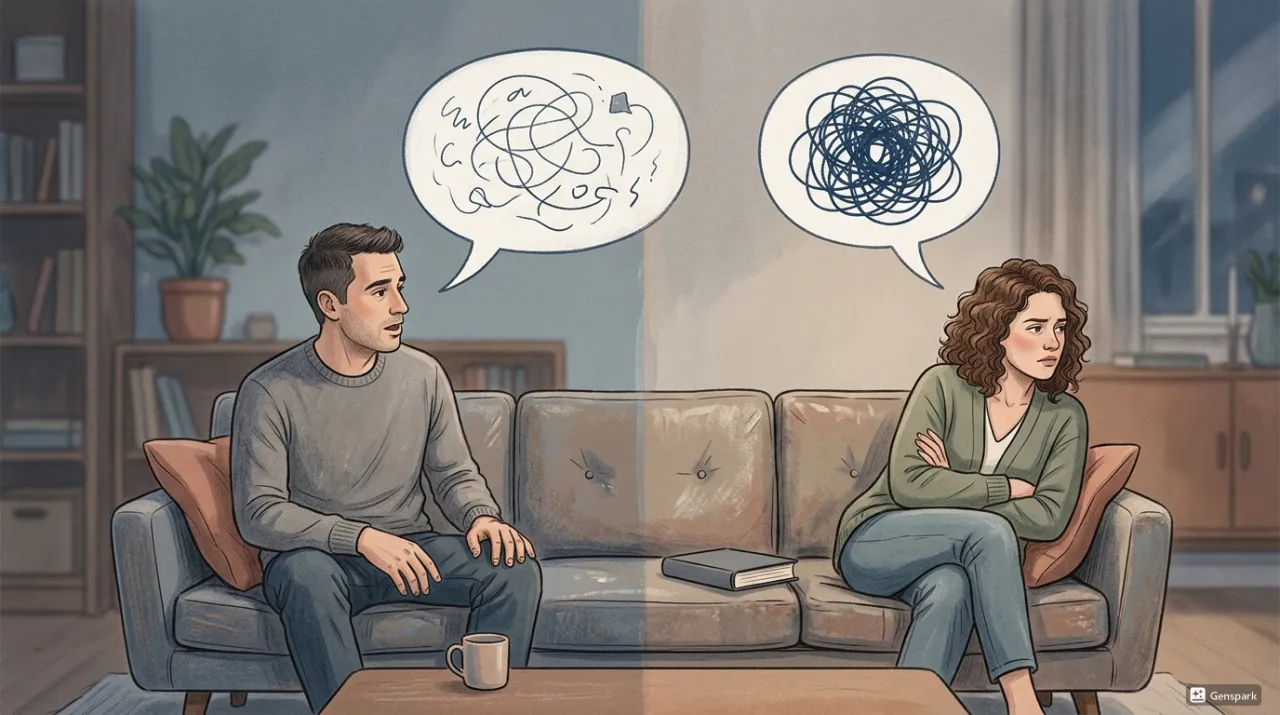
“Why do we talk so much and still feel more frustrated every time?”
In the winter of 2023, I listened to a couple talk and began to understand what that sentence really meant. They were definitely saying a lot. They texted often, and when they met, they talked for a long time.
But whenever an important issue came up, both of them quickly became exhausted. One said, “You never listen to me,” and the other shot back, “So this is about how I did something wrong again?”
Watching that conversation from the side made me realize that “we cannot communicate” does not always mean there are not enough words. Sometimes there are plenty of words, but they never reach the other person’s heart. One person thinks they are explaining their feelings, while the other hears blame.
“We do talk. The problem is that our words do not get through.” I once said that myself.
At the time, it felt incredibly frustrating. We talked a lot. When we fought, we talked for hours. We exchanged long messages. We both tried to explain our positions.
But after each conversation, I felt even more drained. It did not feel like the problem had been solved. It felt like we had circled the same spot again and again. Instead of understanding each other’s hearts, we each ended up confirming our own resentment even more.
The clearest memory I have is from a Saturday night in the first week of November 2022. We were supposed to have a nice dinner at a pasta restaurant near Exit 11 of Gangnam Station. But my partner was thirty-five minutes late.
I was waiting outside the restaurant. The first ten minutes were fine. After twenty minutes, I started to feel hurt. After thirty minutes, I was angry.
By the time my partner arrived, my face had already hardened. They sat down and said, “Sorry. Traffic was terrible.”
I immediately asked, “You could have told me in advance if you were going to be late.”
They answered with a slightly irritated expression, “I said I was sorry. Why are you being so sensitive over being a little late?”
That was the start. What hurt me more than the lateness was the reaction that came afterward.
“So I’m being sensitive? I waited thirty-five minutes.”
They said, “I wasn’t late on purpose. You always make me feel like I’m being attacked.”
We argued through almost the entire meal.
I said, “What hurts me is not just that you were late. It hurts that instead of really being sorry, you’re calling me sensitive.”
They said, “I became defensive because you looked angry from the very beginning.”
From each person’s point of view, both statements had some truth. But the real problem was that neither of us was listening.
I wanted my hurt to be acknowledged. My partner wanted me to understand that they had not done it on purpose. But the conversation went like this:
“Why are you always late?” “It’s not always.” “That’s not the point.” “Then what is the point? I already said sorry.”
We were using the same language, but we were fighting completely different fights. On the way home, I kept thinking, “Why is it so impossible for us to communicate?”
Only later did I realize that the problem was not that we were not talking. The problem was that we were trying to persuade each other instead of trying to understand each other.
The first reason communication fails is that the conversation starts like criticism
The first thing I said at that pasta restaurant in Gangnam was: “You could have told me in advance if you were going to be late.”
Even now, I do not think the sentence itself was wrong. If you are going to be late, it is right to let the other person know.
But how that sentence sounded to my partner was a different issue. It probably sounded like this:
“You are not even considerate about basic things.” “You did something wrong again.” “I am already angry, so get ready to defend yourself.”
I thought I was talking about the situation. My partner felt attacked. So they immediately defended themselves.
“Traffic was bad.” “I did not do it on purpose.” “I already said sorry.” “You are being too sensitive.”
Once that happens, the conversation stops being problem solving and becomes a trial over who is responsible.
What I actually wanted to say was more like this: “I felt hurt waiting alone for thirty-five minutes.” “I know you can be late, but because there was no message in the middle, I felt like I was not important.” “Next time, I would appreciate it if you could send even a short message when you think you might be late.”
If I had started that way, the mood might have been different. Of course, there is no guarantee that my partner would have received it perfectly. But at least it would not have felt as much like I was cornering them from the very first sentence.
That was when I learned how important the opening of a conversation is in a relationship. If the first sentence sounds like criticism, the other person usually becomes defensive before they even hear the content.
When the conversation begins with “Why are you like this?” the other person responds with “What did I do so wrong?” When it begins with “I felt hurt then,” there is at least a chance that the feeling will be heard.
Many couples do not feel unheard because they do not understand the literal meaning of each other’s words. They feel unheard because the moment the words sound like an attack, the ability to listen switches off.
The word “sensitive” closed the conversation
There was one phrase that hurt me the most in that relationship: “You are too sensitive.”
At first, I thought it was not a big deal. But after hearing it again and again, it became harder to talk about my feelings.
When I mentioned the issue of lateness, I was being sensitive. When I said I felt hurt because the texting had decreased, I was being sensitive. When I said a tone felt cold, I heard, “Why do you take everything that way?”
One time in December 2022, something similar happened at a cafe in Seongsu. I told my partner that a joke they made about me in front of friends had bothered me. It was not a huge insult, but I felt uncomfortable that my mistake had become a small joke in front of everyone.
I said carefully, “What you said earlier was a little embarrassing for me.”
My partner put down their coffee and said, “It was just a joke. Why do you take things so seriously?”
At that moment, I no longer wanted to talk.
What I wanted was not a grand apology. Something like this would have been enough: “Oh, that embarrassed you.” “I meant it lightly, but if it felt that way to you, I will be more careful next time.”
But the word “sensitive” turned my feeling from a topic we could discuss into a problem with me. After that, I gradually spoke less.
Before saying anything, I began to think: “If I say this, will I be called sensitive again?” “Am I making too big of a deal out of this?” “Would it be better to just let it pass?”
Eventually, it all built up. Feelings do not disappear just because they are not spoken. Feelings that cannot be talked about often turn into resentment inside the heart.
That is why couples need to be careful with phrases like “you are too sensitive,” “you are overreacting,” or “you are nitpicking.” Those words close the other person’s feelings.
This does not mean the other person is always right. But feelings usually need to be acknowledged first.
“You could feel that way.” “That was not my intention, but I understand that it embarrassed you.” “I see it differently, but I hear your feeling.”
Words like these allow the conversation to continue.
We were not listening. We were waiting for our turn to refute
The biggest reason communication felt impossible was that we were not truly listening to each other. On the outside, we appeared to listen. I nodded while my partner spoke, and my partner seemed to hear me out.
But in reality, both of us were preparing our next line in our heads. When I spoke, my partner looked for the point to refute. When my partner spoke, I looked for the part that felt unfair to me.
For example, I said: “When you are late and do not contact me, I feel ignored.”
My partner said: “I was not ignoring you. I was driving.”
I said again: “I am not saying you intended to ignore me. I am saying that is how I felt.”
They said: “But you never look at my situation.”
Then I said: “Do not say never. I have tried to understand your situation a lot.”
The conversation kept sliding away from the actual topic. The first topic was “Please let me know when you are going to be late.” Before long, we were fighting over “who understands whom less.”
No one feels understood in this kind of conversation. Afterward, what remains is not a solution but exhaustion.
Back then I often said: “That is not the point of what I’m saying.”
My partner said the same thing to me: “That is not what I meant.”
We kept missing the core of each other’s words.
Later, I realized that if a conversation is going to work, you need to check before you refute.
“So you are saying what hurt you was not just that I was late, but that I did not contact you?” “So you felt attacked because I started with an angry face?” “So you wanted apology and understanding first, not just an explanation?”
Those kinds of checks were necessary. But we defended ourselves before checking. Of course the conversation did not work.
We did not know whether the other person wanted empathy or solutions
Another reason our conversations went wrong was that we wanted different things from the conversation.
When I had a hard day, I usually wanted empathy first. “That must have been hard.” “That sounds upsetting.” “From your side, that must have felt really frustrating.”
Hearing those words helped my heart loosen a little.
My partner, on the other hand, looked for solutions first. When I talked about a problem at work, they would immediately say: “Then you should tell your manager that.” “Maybe you are worrying about it too much.” “Next time, do this.”
They were probably trying to help. But when I heard those words, I felt strangely more alone.
One Monday night in January 2023, I called my partner after a tiring day at work. In a meeting, most of what I had prepared was rejected, and I felt quite discouraged.
I said, “Almost everything I prepared got cut in the meeting today. It felt really empty.”
My partner immediately said, “Then next time you should check the direction with your manager earlier.”
The advice was not wrong. But it was not what I needed in that moment.
I said, “I know that. Right now I’m just saying I feel upset.”
My partner was confused. “I was trying to help. Why are you upset?”
This kind of conversation happened repeatedly. My partner thought they were giving me solutions, while I felt they were skipping over my emotions.
The opposite happened too. When my partner talked about a problem, I mainly gave empathy. “That must have been hard.” “That sounds upsetting.” “That person was unfair.”
But one day my partner said: “I wish you would think through a way forward with me. If you only say, ‘That must have been hard,’ I feel stuck.”
That was when I understood: we wanted different things from conversation.
One person wanted comfort. The other wanted a solution. Neither was right or wrong. We just kept missing each other because we never checked.
Since then, I have come to think this question is important: “Do you need empathy right now, or do you want to think through a solution?”
That one sentence can change a conversation a lot.
When someone starts talking about something hard, instead of offering advice right away, you can ask: “Would you like me to just listen, or should we think through what to do together?”
It sounds simple, but it checks the direction the other person wants the conversation to take.
We missed too many small emotional signals
Couples who feel like they cannot communicate do not only fail at big conversations. They often miss small signals too.
“I had a hard day.” “This song is nice.” “I haven’t been sleeping well lately.” “I want to go there sometime.” “I feel a little off today.”
These are not dramatic requests for a serious conversation. But in relationships, they matter a lot.
What those little comments often mean is: “Will you care about my day?” “Will you look at something I like with me?” “I want to lean on you a little.” “Will you notice me?”
I also missed many of these small signals.
Once, my partner sent me a photo on KakaoTalk. It was a sunset they saw on the way home from work. They wrote, “The sky is pretty today.”
I was busy and replied: “It is.”
That was all.
At the time, I thought it was nothing. But when small dismissals like that happen repeatedly, the other person gradually starts talking less.
I have been on the other side too. Once I said, “Today was hard,” and my partner, looking at their phone, replied, “Yeah, good job getting through it.”
The words themselves were not bad. But because they were said without eye contact, I did not want to say anything more.
People do not become close only through big conversations. Small responses build closeness.
“What happened?” “That photo is really pretty. Where is it?” “You sound really tired today.” “Tell me more about that.”
Responses like these create a sense of safety in the relationship.
Couples who feel communication is not working often miss these small signals. Eventually one person says, “There is no point in telling you anyway.”
By the time that sentence appears, many small attempts have probably already failed.
When repair attempts are not accepted, fights last longer
During conflict, there are small attempts to shift the mood.
“Wait, I think we are both speaking too sharply right now.” “Sorry, I said that too harshly.” “I think I am getting defensive.” “Should we take ten minutes and then talk again?”
These are attempts to stop the fight from getting worse. But if those attempts are not accepted, the fight deepens.
I have done this badly before. During an argument, my partner once said: “Sorry. I think I said that too harshly.”
Because I was still angry, I replied: “At least you know. You always do that.”
My partner’s face changed.
Looking back, they had reached out a hand to stop the conversation from collapsing. I slapped that hand away.
I have also experienced the reverse. Once, I said, “I think I said that too harshly too,” and my partner answered, “Now you say that?” Hearing that made me defensive again.
A repair attempt may not be a perfect apology. It may be an awkward attempt to change the atmosphere. But accepting that attempt matters.
Even if you are still angry, you can say: “Thank you for saying that. I’m still upset, but let’s try to talk more calmly.” “I was harsh too.” “Let’s pause and come back to this.”
Small moments like these change the direction of a fight.
Couples who communicate well are not couples who never fight. They are couples who keep a door open for returning to each other even during a fight.
Things I actually tried when communication was not working
I failed at many conversations in that relationship. But through later relationships and watching other couples, I gradually learned a few things that helped.
- Start softly
The first thing to change is the opening sentence.
Instead of: “Why are you always late?” Try: “You can be late sometimes, but I felt hurt because there was no message.”
Instead of: “You never listen to me.” Try: “When you look at your phone while I’m talking, I feel like my story is not important.”
When the conversation starts this way, the other person is less likely to become defensive.
- Summarize the other person before answering
Before refuting, try saying: “So you felt defensive because I looked angry from the beginning?” “So you need my empathy first, not a solution right away?” “So what hurt you was not just that I was late, but that I did not contact you?”
If the other person says “yes,” the conversation changes. They begin to feel understood.
- Separate empathy from problem solving
When someone brings up something difficult, it helps to ask before advising: “Do you want me to listen, or should we think through a solution together?”
That one question can reduce a lot of unnecessary misunderstanding.
- If emotions get too high, pause with a time to return
When the conversation keeps getting tangled, taking a break can help. But it should not be disappearing without explanation. Say something like: “My emotions are too high right now. I want to take twenty minutes and then come back to this.”
The key is to set a time and actually return.
- Respond to small emotional signals
When your partner says, “Today was hard,” you do not need to give a grand solution first. Start with interest.
“What happened?” “You must be exhausted.” “Do you want to tell me more?”
Small responses like these build the basic strength of a relationship.
The MATE test can help identify where conversations get misaligned
When couples cannot communicate, the reason is not only tone. It can also come from differences in communication style, closeness needs, and conflict-processing speed.
Some people feel stable only when a problem is discussed immediately. Others need time to organize their thoughts before they can speak.
Some people want empathy when they share something hard. Others want solutions.
Some people send frequent emotional signals. Others do not notice those signals easily.
Without understanding these differences, couples easily misunderstand each other.
“Why are you so sensitive?” “Why are you so cold?” “Why don’t you say it right away?” “Why do you keep pushing me?”
The MATE test can be a starting point for seeing where two people react differently through areas such as closeness, conflict handling, life rhythm, and relationship management style.
A test cannot solve the conversation for you. But it can turn the vague fear of “Maybe we just do not fit” into a more concrete understanding: “We react differently at this point.”
Once you know the difference, the goal of conversation can change too. Instead of trying to fix the other person, you can understand each other’s styles and look for a middle ground.
Conversation patterns that should not be ignored
Not every communication difficulty is a serious problem. Most couples experience some difference in communication style.
But some repeated patterns are dangerous.
Repeatedly treating the other person’s feelings as oversensitivity. Using sarcasm or contempt. Turning the person who brought up the problem into the problem. Avoiding responsibility without apology. Punishing the other person with days of silence. Responding to every concern with “Here we go again.”
These patterns go beyond simple differences in conversation style. They can damage the sense of safety in the relationship.
Contempt and dismissal are especially dangerous. Sarcastic comments, eye-rolling, “Do I really have to spell that out for you?” or “You are just that kind of person” gradually make the other person close down.
Having difficulty talking is one thing. Lacking respect is another.
Communication methods can be improved. But if there is no willingness to respect each other, the relationship will only grow more exhausting.
Conclusion: communication may fail not because there are too few words
I used to think that if communication was not working, we needed to talk more. Explain more, persuade more, send longer messages, talk on the phone longer, and eventually we would understand each other.
But that was not true.
There can be many words and still no emotional contact.
If a conversation starts with criticism, the other person becomes defensive. If a feeling is called oversensitivity, the heart closes. If someone wants empathy but only receives solutions, they feel alone. If small emotional signals keep being ignored, the will to talk fades.
Communication does not mean making the other person fully understand every word I say.
It means feeling that my emotions are being heard. It means trying to check the other person’s perspective. It means looking at the problem together instead of searching for the wrong person. It means trying to return to the same side even in the middle of a fight.
When those things exist, communication begins to work little by little.
What matters in a relationship is not never fighting. It is whether you can reconnect after a fight.
If conversations keep going wrong, it may help to ask:
Are we speaking to understand each other, or to win? Am I listening, or am I preparing my rebuttal? Does my partner want empathy, or a solution? Are we responding to small emotional signals? When one of us reaches out during a fight, can we accept that hand?
Recovery can start from these questions.
You might also enjoy:
- What Silence Means in a Relationship — Avoidance or Consideration?
- Why Low Self-Esteem Can Make Dating So Hard
Frequently Asked Questions
Q. Does poor communication mean our personalities do not match?
Personality differences can play a role, but in many cases the core issue is the communication pattern. Even if personalities are different, the relationship can be stable if both people check what the other means, acknowledge feelings, and accept repair attempts during conflict.
On the other hand, even similar personalities can struggle if criticism, defensiveness, contempt, and stonewalling repeat.
Q. What should I do if my partner keeps saying I am too sensitive?
If every emotional explanation is dismissed as oversensitivity, the conversation cannot move forward. You can say: “Rather than deciding whether I am being sensitive, I would like you to first hear why I felt that way.”
Feelings are not always the same as facts, but feelings still deserve respect as the starting point of a conversation.
Q. I try to give solutions. Why does my partner feel hurt?
Your partner may be looking for empathy, not a solution. When someone shares something hard, immediate advice can feel like their emotion has been skipped.
Try asking first: “Do you want me to just listen right now, or should we think through what to do together?”
Q. What should I do when someone shuts down during a fight?
Pushing immediately can make them shut down even more. Sometimes emotions are too high for a person to speak.
You can say: “It looks hard for you to talk right now. Should we take twenty minutes and then come back to this?”
Taking time can help, but the conversation should be resumed afterward.
Q. Can it help if only one person changes the communication style?
It can help to some extent. If one person starts speaking about feelings instead of blaming, summarizes the other person’s words, and accepts repair attempts, the interaction pattern may begin to shift.
But for stable long-term change, both people need willingness to change how they communicate.
Q. What if we talk a lot but still never solve anything?
The amount of talking matters less than the way the conversation is handled. Repeating the same topic will not solve it if the conversation is only criticism and defense.
Try setting a time to talk, focusing on one topic at a time, and summarizing each other’s words before responding. If the same pattern keeps repeating, couples counseling or professional support may be worth considering.