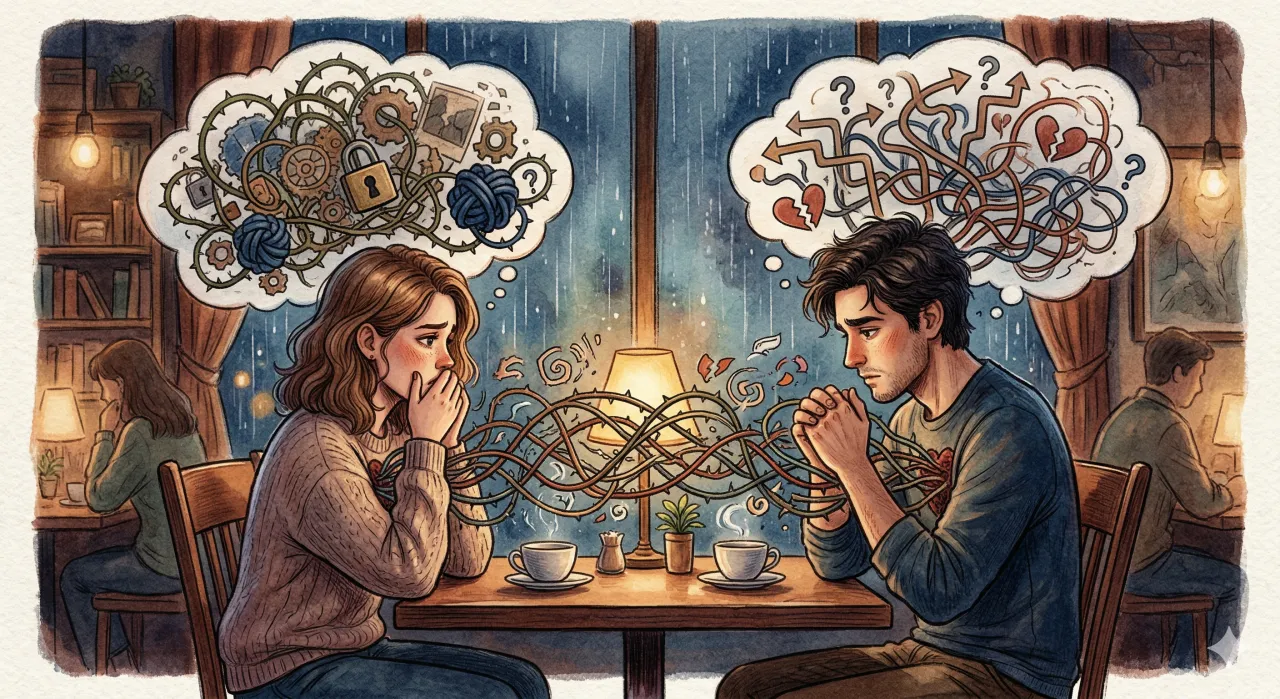
Around June 2023, there was a period when I found it hard to tell my partner that I felt hurt. It was not because of one dramatic incident. It was more that whenever we made plans, I felt like I was the one adjusting more often, and small disappointments around the way we communicated kept building up.
But whenever I tried to say something, the words would not come out easily. The first thought that came up was, “Will I sound too sensitive if I bring this up?” So for several days, I pretended nothing was wrong.
On the outside, I replied as usual. Inside, though, I had already replayed the conversation dozens of times by myself.
Eventually, one day, my feelings suddenly burst out because of one small tone of voice. From the other person’s point of view, it probably looked like I had suddenly gotten angry. But inside me, it had been piling up for a long time.
“Can’t you just say it honestly?”
I used to think that way too. If something hurts you in a relationship, you say it. If you want something, you say it. If something feels uncomfortable, you talk it through. But once I was actually inside my own relationship, it was not that easy.
With friends, I could say things pretty well. “I’m not feeling great today.” “That comment hurt a little.” “I don’t really like that.” Those words were not especially hard with friends. But strangely, in front of my partner, my mouth would not open.
Even if I did not like the date location, I said, “It’s fine.” Even when I was tired, I said, “If you want to meet, let’s meet.” Even when my partner’s tone hurt me, I brushed it off with, “No, it’s nothing.”
At the time, I thought I was being considerate. I did not want to start a fight. I did not want to tire the other person out. I did not want to ruin the good mood.
But after some time passed, I realized it was not only consideration. I was afraid that if I spoke honestly, the other person might become distant.
“Will I look too sensitive if I say this?”
“Will I ruin the mood for no reason?” “What if they think I’m exhausting?” “Maybe it will pass if I just endure it.”
Because of those thoughts, I often swallowed my words.
The problem was that unspoken feelings did not disappear. They quietly piled up inside me, and later even a tiny thing could make me feel deeply hurt.
Speaking honestly to someone you love is harder than it sounds. Not because you do not like them, but because you like them so much. You do not want to lose them. You do not want to shake the relationship. So before you even speak, fear arrives first.
This is not a piece of writing that simply says, “Just be honest.” Because I know from experience how hard that is, I want to sort through why it can be so difficult to be honest with a partner, and how we can slowly practice saying what we really feel.
Why Did I Say “It’s Fine” So Often?
Looking back on past relationships, one of the things I said most often was, “It’s fine.” Sometimes I really was fine. But there were many times when I said it even though I was not fine at all.
When my partner was late, I said it was fine. When they chose a place I did not want to go, I said it was fine. When their tone felt a little cold, I said it was fine. When they made plans without asking my opinion, I said it was fine.
In that moment, saying “It’s fine” was the easiest thing to do. If I said it was fine, there was no fight. The other person did not have to feel sorry, and the mood did not break.
But when I came home and was alone, my heart changed.
“Why did I say it was fine again?”
“I was actually a little hurt.” “Should I have said something then?” “But if I had said it, maybe we would have fought.”
I repeated thoughts like that again and again.
Once, during a date, we went to eat something I did not really want. My partner wanted it, so I just went along with it. It seemed like nothing. But several similar things happened that day. My partner chose the café, decided the route, and I kept saying only, “Sure,” “It’s fine,” and “I don’t mind.”
That night, my mood sank strangely. The other person had not done anything terrible, and there had not been a big fight. But inside, I had this thought:
“I almost wasn’t there today.”
That was when I realized something. A relationship that is not honest does not always mean telling big lies. It can also mean pushing your own heart to the back in small moments.
A menu, a café, one day when you want to rest. If you keep not saying these small things, at some point your place inside the relationship starts to shrink.
The other person does not know. I said I was fine.
So now, before I say “It’s fine,” I try to ask myself once: “Am I really fine?” “If I say I’m fine now, will resentment remain later?” “Would it be better to say even a small part of my opinion?”
Honesty did not start with a big confession. It started with a very small sentence like, “Today, I want to eat this.”
Before I Spoke, I Had Already Been Rejected in My Head
The biggest reason I could not speak honestly to my partner was not the other person’s actual reaction. It was the reaction I had already imagined in my own head.
For example, there were times when I felt my partner’s messages had become less frequent. I felt hurt. But I could not say it right away.
When I tried to say something, this scene came up first in my mind.
If I said, “I feel hurt because we seem to be messaging less lately,” I imagined my partner looking tired and saying, “You know I’ve been busy. Why can’t you understand that?”
Then I would feel guilty, my partner would feel burdened, and the atmosphere would turn cold.
That conversation had not actually happened. But in my head, I had already fought several times. And I had already reached a conclusion.
“Don’t say anything. If I say it, things will only get worse.”
So I held it in for days. But while I held it in, my feelings did not improve. Instead, I began to read every action more sensitively.
If a reply was late, I wondered, “Are they losing feelings?” If the tone was short, I wondered, “Am I annoying?” If they said they were busy, I wondered, “Have I been pushed down their list of priorities?”
Eventually, one day, I could not hold it in anymore and brought it up. But their actual response was different from what I had imagined.
“You felt that way? I guess I was so out of it lately that I didn’t pay enough attention.”
Hearing that actually startled me. I had spent days building the worst-case scenario all by myself.
Of course, not every conversation ended that well. Some conversations did turn into fights. Still, I learned something from those experiences.
The reaction I expect from the other person is not always the truth.
When it was hard for me to speak honestly, I was often fighting not with the real person in front of me, but with the person I had created in my head.
“They will definitely get angry.”
“They will think I’m exhausting.” “This one sentence will make the relationship more distant.”
Those thoughts felt so real.
So now, before I begin a difficult conversation, I try to separate things. What have I actually confirmed? What reaction am I imagining? Am I more afraid now because of a similar experience from the past?
Just making that distinction lowers the threshold for starting a conversation a little.
I Thought Enduring Made Me a Good Person, but Eventually I Burst Out Sharply
I used to think that enduring things was a way to protect the relationship.
If I endured a little disappointment, we could avoid fighting. If the other person looked tired, I could talk about my feelings later. If it was a small issue, letting it pass seemed like the mature thing to do.
The problem was that I was not actually someone who could let things pass well. On the outside, I let them pass. Inside, I kept remembering them.
Once, we had a big fight over being late. My partner had been late to plans a few times, and at first I did not say much.
“It’s fine.”
“That can happen.” “Just tell me earlier next time.”
That was what I said.
But when similar things repeated, I exploded at some point.
That day, my partner was about ten minutes late. If you looked only at that day, it was not such a huge problem. But I piled all the feelings I had been holding onto those ten minutes.
“Why are you always like this?”
“It feels like you take my time too lightly.” “Did you think I was really fine just because I kept saying I was?”
My partner was confused.
“You kept saying it was fine. Why are you suddenly this angry?”
That made me even angrier at the time. But later, I could understand the other person’s point of view too. I had kept saying I was fine. They may really have thought I was fine.
I thought I was enduring. In reality, I had not communicated properly.
That taught me something. Hurt feelings should be spoken when they are still small. If you endure them for too long, it becomes hard to speak calmly.
At first, I could have said, “You can be late sometimes, but because it has happened repeatedly, I feel a little hurt.”
Later, it came out as, “You’re always like this.”
Then the other person hears an attack before they hear my feelings.
Honesty is not a sentence meant to create a fight. It is a way to bring out a feeling while it is still small, before it becomes a much bigger fight.
Now, when I feel hurt, I try not to explode right away and also not to swallow it completely. Instead, I try to say things like:
“This isn’t a huge issue right now, but I think I’ll keep thinking about it, so I want to say it.” “I’m not trying to fight. Next time, I’d like it if you could do this.” “I felt a little hurt then. I’m not saying that was your intention.”
Even that much makes the relationship feel much less heavy.
While Trying to Show Only My Good Side, the Real Me Disappeared
Especially in the beginning of a relationship, I wanted to show only my good side.
I wanted to seem cool. I wanted to seem understanding. I wanted to seem like someone who did not burden the other person.
So even when things were hard, I said I was fine. Even when I felt jealous, I tried not to show it. Even when I felt anxious, I tried to solve it alone.
At the time, I thought that was mature love.
But strangely, as time passed, I felt lonely. I was meeting my partner often, we were texting, and I was clearly in a relationship, but a part of my heart felt unfilled.
Later, the reason seemed simple. The person my partner liked was only the part of myself I had shown.
The me who always pretended to be fine. The me who always pretended to understand. The me who acted like nothing was wrong even when I was struggling.
The truly tired me, the hurt me, the anxious me—those parts never entered the relationship.
So even while being loved, I wondered: “If this person knew the real me, would they still like me?”
Once that question appears, a relationship does not feel comfortable.
Showing weakness does not mean pouring every emotion onto the other person. It does not mean demanding that they solve all your wounds.
It just means showing, little by little, that you are not always okay.
“I’ve been a little worn out lately.”
“I hesitated to bring this up because I was worried it would feel burdensome.” “I’m not asking you to fix it. I just want you to listen.” “I was actually a little hurt then, but I couldn’t say it right away.”
At first, saying these things feels very awkward. But these are the kinds of sentences that deepen a relationship.
A relationship where you only show your good side can look peaceful, but at some point it may feel empty. When honest parts of you slowly enter the relationship, you begin to feel, “This person can see me not only when I’m okay, but also when I’m imperfect.”
Speaking Honestly and Hurting Someone Are Not the Same
I think I used to misunderstand honesty a little.
I thought being honest meant saying exactly what was in my heart. But through relationships, I learned that honesty also needs a way of being expressed.
Just because my emotion is real does not mean I can say it any way I want.
“You’re so selfish.”
“Why are you always like this?” “It’s impossible to talk to you.” “Honestly, you make me so tired.”
Those words may come from real feelings. But to the listener, they sound like attacks.
I once spoke like that after holding in my hurt for too long. From my side, I was telling the truth. But my partner was hurt by my tone before they could hear my heart.
At the time, I felt wronged. “I’m just saying how I feel. Why can’t you accept it?”
But later, I realized that I was not explaining my feelings. I was evaluating the other person.
The same feelings could have been said this way:
“I felt like I was being pushed to the side then, so I was hurt.” “Maybe you didn’t mean it that way, but those words hurt me a little.” “I’m worried that when we talk these days, we both become defensive.” “I think I would feel much less anxious if you told me in advance when you’re going to be late.”
These sentences are much harder. You have to explain your feelings accurately instead of blaming the other person.
But if you want to protect the relationship, this way of speaking is necessary.
Honesty is not speaking harshly. It is speaking precisely. It means not hiding your heart while also not attacking the other person. That is the kind of honesty a couple needs.
Truths Brought Up Late at Night Often Became Fights
One mistake I made often was timing.
I would endure things all day, and then bring them up at night when I was lying down and my thoughts became heavy.
My partner was already tired. I had already built up emotion. So of course the conversation did not go well.
I felt, “I finally found the courage to say this, so why aren’t they listening properly?” The other person felt, “Why are you bringing this up right now?”
Neither side was entirely wrong. The timing was not good.
For important conversations, timing matters as much as content.
When the other person is exhausted, when emotions are already high, after drinking, right before sleep, or at a time when it will feel even more frustrating if nothing is resolved—
bringing up your deepest feelings then can easily turn into a fight.
Now, when I want to have an important conversation, I think it is better to begin with something like:
“Is now an okay time to talk?”
“It’s a little serious, but do you have a moment today?” “I’m not trying to fight. I want to tell you something I felt.” “If you’re too tired now, we can talk tomorrow.”
That one sentence changes the atmosphere a lot.
Honesty should not be a bomb suddenly thrown into the room. It should be something brought out in a way that both people can hold together.
Later I Learned That My Silence Was Hard for the Other Person Too
I thought that if I did not speak, the other person would be more comfortable.
If I did not talk about my hurt, they would feel less burdened. If I said I was fine, the relationship would stay peaceful.
But later, I learned that my silence was not always comfortable for the other person either.
Once, I was clearly in a bad mood but kept saying nothing was wrong. My face had already hardened, and I was speaking less, but I kept saying, “Nothing happened.”
My partner asked me several times.
“Is something wrong?”
“Are you upset?” “Did I do something?”
I kept saying no.
At the time, I was avoiding the conversation because I was afraid it would become a fight. But from their side, it must have been even more frustrating. They could feel that something was wrong, but because I would not speak, there was no way to know what it was.
Later, my partner said: “I’d rather you tell me what hurt you. If you say nothing, I just keep walking on eggshells.”
That surprised me.
I had thought my silence was consideration. But to the other person, it could become anxiety.
A person who is not honest is not the only one who suffers. The other person suffers too.
If I do not speak, the other person has to guess. They have to keep watching my mood and trying to figure out what the problem is. Over time, that becomes exhausting too.
Honesty is for me, but it is also for the other person.
The peace that comes from not speaking does not last as long as we think. Real peace begins when we can gradually know each other’s hearts.
Practicing Honesty Started with Very Small Words
I did not suddenly become an honest person one day.
At first, I began with very small sentences.
“Today, I want to eat this.”
“I’m a little tired this week, so I want one day to rest.” “What you said earlier hurt me a little.” “When replies are going to be late, I feel more comfortable if you tell me in advance.” “That’s okay, but next time I’d like you to ask my opinion too.”
At first, even those sentences felt awkward. I was nervous that the mood would change.
But in many cases, the other person did not react as dramatically as I feared.
“Oh, really?”
“Okay. I’ll do that next time.” “Thanks for telling me.”
Of course, it did not always end ideally. Some conversations were awkward, and some became small fights. Still, after speaking, at least I felt that my heart had entered the relationship.
That was much better than storing everything alone without saying anything.
Honesty requires practice.
You do not have to reveal your deepest wounds from the beginning. You do not have to speak perfectly from the start.
You can begin by stating a small opinion, a small hurt, a small request.
When those experiences accumulate, you start to feel, “Saying something does not make the relationship collapse immediately.”
For me, that feeling mattered.
The MATE Test Can Become a Starting Point for Seeing How Each Person Speaks
People differ in the way they speak honestly.
Some people, like me, need to think a lot before they can finally speak. Some people need to say what they feel right away in order to feel resolved. Some people use silence to organize their emotions. Some people experience silence as rejection.
When you do not know these differences, it is easy to misunderstand each other.
One person thinks, “Why won’t you say anything?”
The other thinks, “Why won’t you even give me time to think?”
One person believes speaking immediately is honesty. The other feels burdened by words that are spoken before they are organized.
The conflict handling, closeness, daily rhythm, and operating style axes in the MATE test can be a starting point for talking about these differences.
Am I someone who feels stable only when we talk right away?
Am I someone who needs time to organize my thoughts before speaking? Do I interpret my partner’s silence as avoidance? Does my partner use silence as emotional processing?
When you know this, the conversation can shift from “Why don’t you talk?” to “You need time before you can speak.”
The test does not provide the answer. But it can turn vague frustration into language that can be discussed.
Difficulty Speaking Honestly Is Not Always My Problem
One thing must be separated clearly.
If it is hard to speak honestly to your partner, it does not always mean you are timid, avoidant, or lacking courage.
If the other person usually ignores what you say, gets angry whenever you speak, labels your feelings as “too sensitive,” makes sarcastic comments, punishes you with silence, or later uses the vulnerability you shared as a weapon, then anyone would find it hard to be honest.
In that kind of relationship, the problem may not be that you cannot speak. It may be that there is no safety for your words.
Honesty grows inside a safe relationship.
It matters that I find courage, but it also matters whether the other person is ready to listen. A relationship is not made by one person alone.
So it is worth asking yourself:
“Am I a person who is afraid to speak?”
“Or is this a relationship that does not receive my words safely?”
Those are different.
There are times when I need to practice speaking little by little. But there are also times when I need to look at the other person’s attitude because it keeps breaking down my honesty.
Conclusion: Honesty Was Not a Way to Shake the Relationship, but a Way to Protect It
I used to be afraid that speaking honestly would shake the relationship.
If I said I was hurt, I thought we would fight. If I said I was uncomfortable, I thought the other person would be disappointed. If I brought out my feelings, I thought the mood would become heavy.
So I swallowed a lot.
But after time passed, I learned that swallowing words does not make a relationship safe.
Unspoken feelings did not disappear. Hurt piled up behind the word “fine.” The other person could not know what I wanted. And I grew smaller inside the relationship.
Honesty does not have to be a word that breaks a relationship. It can be a word that is necessary to protect it for a long time.
Of course, honesty needs a way of being spoken.
Not attacking the other person. Speaking from my own feelings. Choosing the timing. Not pouring everything out at once. Starting with small things.
These things take practice.
You do not have to become perfectly honest. You can say one thing today.
“Actually, I felt a little hurt by this.”
“Today, I want to eat what I want.” “That comment sounded a little painful to me.” “I was scared to talk about this, but I still wanted to try.”
When these small sentences build up, a relationship slowly changes.
Honesty is not a test of love. It is a door to knowing each other better.
And I believe the person who slowly opens that door can eventually build a deeper relationship.
Frequently Asked Questions
Q. What if I speak honestly and my partner gets angry?
You cannot completely control the other person’s reaction. But you can adjust how you speak. It is better to say, “I felt a little hurt then,” than “Why are you always like that?” Your partner may react defensively at first. What matters is whether you can talk again after emotions settle. If your partner repeatedly gets angry or dismisses you, that may not be only a matter of your wording. It may be a problem of safety in the relationship.
Q. I keep saying I’m fine and then feeling hurt alone later. What should I do? Before saying “It’s fine,” pause for a moment. Check whether you are really fine, or whether you are saying it just to avoid an uncomfortable mood. You do not have to say something big from the beginning. “It’s not a huge issue, but honestly, I did feel a little hurt.” Even that can be enough of a start.
Q. Is it strange that I can be more honest with friends than with my partner? No, it is not strange. Because romantic relationships involve a deeper emotional investment, people can become even more careful. The more you do not want to lose someone, the harder it can be to speak. Still, in the long run, it is necessary to practice being honest with your partner little by little. The closer the relationship, the more distance can grow if you keep hiding your real feelings.
Q. How can I tell the difference between honesty and hurtful words? Honesty explains my feelings. Hurtful words judge or attack the other person. “I felt hurt then” is honesty. “You really have no consideration” is closer to an attack. It is important not to hide your heart, while also not defining the other person’s character.
You might also enjoy:
Q. When is it good to start having deeper conversations?
It depends on the pace of the relationship. Bringing up very deep things all at once from the beginning can feel burdensome for both people. But if you have been together for a long time and still never talk about emotions, values, fears, or the future, it is difficult for the relationship to deepen. It is better to begin with small honesty, and then gradually move into deeper conversations as experiences of being received safely build up.