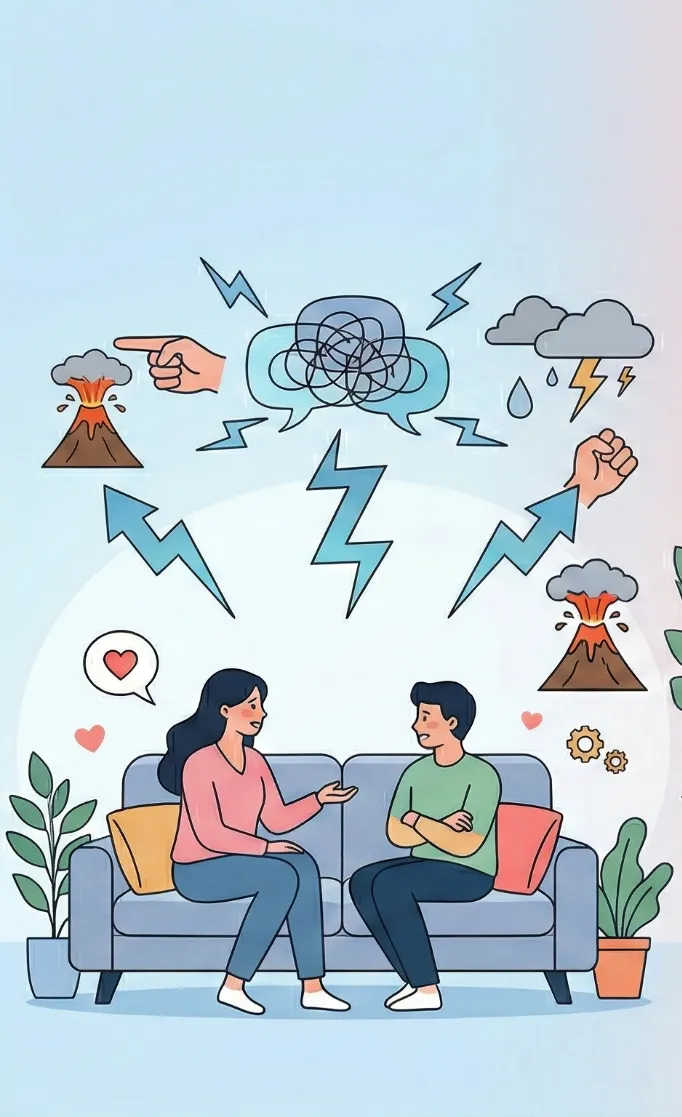
I still remember a short trip to Gangwon-do in August 2023. I was traveling with a couple I knew well, and at first the mood was good. The problem started at a transfer stop where we had to change buses. It was hot, the suitcases were heavy, and everyone was hungry.
One of them said, “Let’s stop by a café for a bit.” The other said, “If we go just a little farther, there’s a better place near our destination.” From the outside, it was a small exchange. But to someone already exhausted, it probably sounded like, “Can’t you see that I’m struggling?”
After a few words, one person really turned around and left. The other was left standing in the middle of the bus stop, holding the suitcase. They made up later, but what was said and done that day did not disappear easily. The feeling that “this person might leave me behind” cannot be erased with one apology.
Can couples avoid fighting altogether?
I used to think that if I met someone who truly fit me, we would not fight much. Since we liked each other, I thought most things could be understood and passed over. But once I actually experienced relationships, I realized it was not that simple.
Even when two people love each other, their daily habits differ, their standards for communication differ, and their ways of expressing disappointment differ. Some people need to talk immediately to feel relieved. Others need time alone to organize their thoughts. Something that feels acceptable to one person may remain as a wound for the other.
In my twenties, I went through many big and small fights. Looking back, the reasons were rarely dramatic. A late reply, a lack of consideration while deciding where to meet, a cold tone, or feeling unseen when tired — that was usually how it began.
But what stayed with me the longest was not the cause of the fight. It was what was said during the fight, what expression the other person had, and how far the behavior went when emotions rose. Sometimes a fight begins over something small, but the heart cools after it ends. Other times, even after a serious disagreement, the relationship becomes more honest because both people protected the lines they should not cross.
So I no longer think the key is “not fighting.” The key is fighting in a way that does not destroy the relationship. This is not advice from someone who loved perfectly. It is a reflection from someone who has made mistakes, been hurt, and later regretted the words said in anger.
Even after the fight ends, the words remain
I once thought that once a fight was over, everything was over. If we apologized, ate together again, and texted like usual, I thought the relationship had recovered. But that was not always true. Some words remained in the corner of the heart: “You’re always like this,” “You have no consideration,” “Talking to you is impossible,” or “If that’s how it is, let’s break up.”
These words may be thrown out in anger, but they last. Even after reconciliation, they return when a similar situation appears. You begin to wonder, “Does this person really think of me that way?” “Has this person always seen me like that?” “Will they say the same thing next time?” When those thoughts appear, the next argument grows faster. You become sensitive to every word and more defensive.
That is why what matters in a couple’s fight is not only what caused the fight, but how much the two people hurt each other while fighting. Problems can be solved. Words that break a person are much harder to repair.
First line: Do not attack the person themselves
I also used to say “You’re always like this” too easily. At the time, I thought I was simply expressing frustration. But later I realized that the sentence did not solve the problem. To the other person, it may not sound like “your action hurt me.” It may sound like “you as a person are the problem.”
For example, if someone is late, “I waited a long time today and felt hurt” talks about the incident. But “You have no sense of time” or “You only think about yourself” judges the person. Once someone feels attacked as a person, they become defensive: “Have you always done everything right?” “You did the same thing last time.” The original issue disappears and the fight becomes a judgment of each other’s character.
What I learned is this: talk about behavior, but do not define the person. “I felt hurt because you were late” is possible. “You are an inconsiderate person” is dangerous.
Try changing the words: “You’re always like this” → “Because this keeps happening, I feel tired and hurt.” “You’re selfish” → “I wish you would consider my side a little more.” “Talking to you is impossible” → “Right now we seem to be missing each other’s point. Let’s pause and talk again.”
In the middle of a fight, these words do not come out easily. That is why practicing them in calm moments matters. When you speak to win, the words become sharp. When you speak to protect the relationship, the expression changes.
Second line: Do not suddenly disappear because you are angry One scene remains vivid for me. In my twenties, I was going on a trip with my girlfriend. We got off the bus at a transfer stop in the middle of summer. It was extremely hot, and we were carrying luggage, so both of us were tense.
She said, “Let’s stop by a café.” I thought there was one near the next stop and said, “If we go a little farther, there’s a café. Let’s go there.” Looking back, I was not exactly wrong, but I was not kind either. I should have first noticed that she was tired and hot.
She suddenly said, “I’m just going home,” and really walked away. I stood alone with the luggage in the middle of the transfer stop. I did not just feel angry. I felt miserable. “Did I do something so wrong?” “Can I be left alone over something this small?” “Am I someone who can be abandoned this easily in this relationship?”
Since then, I have understood how deeply it can hurt to storm off during a fight. The person leaving may think they are preventing the fight from getting worse. But the person left behind often feels rejected.
Taking a break is necessary sometimes. When emotions are too high, stopping can be healthier than continuing. But taking a break and disappearing are different. “I’m too angry right now. Let’s take 20 minutes and talk again” protects the relationship. Leaving without a word, hanging up and blocking, ignoring contact all day, or slamming the door can feel like punishment.
If you need to pause, leave the other person with safety: “I’m not avoiding this. I want to calm down and talk again.” “If we keep talking now, we may hurt each other. Let’s talk again in 30 minutes.” “I need to be alone for a while, but let’s finish this today.” That one sentence makes a huge difference.
Third line: Do not use the past as a weapon
When you fight with someone you love, the past rises up strangely. A late reply today reminds you of a canceled plan last month. A cold tone today reminds you of a disappointing birthday last year.
I have also said, “You did that back then too,” “This isn’t the first time,” and “You’re always the same.” At the time, I thought I was right because the current anger was not only about today. Things had built up. But once I brought up the past, the focus blurred. We stopped discussing today’s late reply and began arguing about who hurt whom more last year.
The person bringing up the past wants to say, “This has accumulated inside me.” But the listener may feel, “I have been branded as someone who always does wrong.” Then defense comes before apology: “You started it then,” “I already apologized,” “Why bring it up again?”
Repeated problems should be discussed. But the way matters. “You did this last year and last time too; you never change” is an attack. “When this situation repeats, I become anxious and tired” explains a pattern. The past should not be evidence used to corner the other person. It should be mentioned only enough to explain why the present hurts.
Fourth line: Do not pull friends or family onto your side
When love is difficult, it is natural to talk to people around you. I have told friends about relationship problems too. Sometimes it helps you see whether you are being sensitive or whether the other person really did something wrong.
But getting advice and using it as a weapon are completely different. During a fight, phrases like “My friend thinks you’re weird too,” “My mom doesn’t understand you either,” “Anyone would say you’re wrong,” or “Is your family always like that?” do not sound like simple opinions. They make the other person feel judged by a group of invisible people.
They also damage trust. The other person may think, “You told outsiders everything about us,” “I was described as the bad person without knowing,” or “How should I face that friend or family now?” Family comments are especially dangerous because they touch the person’s background, parents, and home. Words like “Is your family always like that?” can remain for a long time.
I do not think it is wrong to seek advice. But the purpose matters. Are you trying to organize your feelings? Are you trying to make your partner look bad? Are you preparing evidence for the next fight? Couple conflicts are best solved between the two people whenever possible. Even when advice is helpful, it should not be held like a knife during an argument.
Fifth line: Do not use “let’s break up” as a threat
One of the heaviest phrases in a relationship is “Let’s break up.” Of course, if you truly want to end the relationship, that conversation must happen calmly. But many times, “let’s break up” in a fight is not a final decision. It is an emotional explosion.
Behind it may be “I’m suffering,” “Please understand how hurt I am,” or “Please hold onto me.” But the listener cannot always read that. It simply sounds like the whole relationship is shaking. When I heard “let’s break up” during a fight, I could no longer focus on the issue. Anxiety came first: “Do they really mean it?”
The first time, you may hold on. The second time, you may persuade. But if it repeats, a person becomes tired. “This person can leave me whenever things are hard.” “We do not solve problems; we put the whole relationship on the line.” The safety of the relationship collapses.
If what you really mean is “I’m exhausted,” say that. “I’m really tired because of this issue.” “If this repeats, our relationship will become difficult.” “I don’t want to break up; I want you to take this seriously.” These words are already heavy enough. A breakup is not a bargaining chip.
Couples who fight well set rules when things are good
It is hard to become a calm and kind person in the middle of a fight. When emotions rise, words get faster, voices get louder, and even a small expression can feel like an attack. That is why rules should be made when you are not fighting.
When the mood is good, talk about rules like: “No matter how angry we get, let’s not say break up.” “If we need space, let’s say how long and when we will return.” “Let’s not bring up the past to attack.” “Let’s not drag friends or family into it.” These rules do not make every fight beautiful, but they create a brake. They are not cold. They are promises made because the relationship matters.
Rules that actually helped
-
Take 20 minutes when emotions are too high. Say, “I’m too worked up and my words may come out harshly. Let’s take 20 minutes and talk again.” This tells the other person you are coming back.
-
Ban “you always” and “you never.” These phrases trap the other person. Say instead, “Because this keeps happening, I’m struggling,” or “This incident felt big to me.”
-
Talk about one problem at a time. If the issue is communication, talk about communication. If it is lateness, talk about lateness. If it is tone, talk about tone. One issue is already enough.
-
Apologize specifically. “I’m sorry” matters, but it helps more to say, “It was wrong of me to interrupt you,” “I reacted defensively when you said you were hurt,” or “Saying ‘you always do this’ was too harsh.” A good apology shows that you saw the wound accurately.
Some fights may not be simple arguments
Everything above is about ordinary couple conflict. But not every fight is a simple argument. Repeated verbal abuse, threats, throwing objects, physical violence, monitoring, control, forced unwanted contact, or financial control may not be solved by changing communication habits. In those situations, safety comes first. Reach out to trusted people, counseling organizations, or public help if needed. Healthy conversation is possible only when there is a basic promise not to harm each other.
You might also enjoy:
- Why Couples Who Apologize Well Last Longer
- The Psychology of Relationship Boredom — Is Losing the Spark Normal?
Frequently Asked Questions
Q. If a couple fights often, does it mean they are incompatible? Not necessarily. What matters is what remains after the fight. If you understand each other better, a fight may help. But if every fight includes personal attacks, disappearing, or breakup threats, the relationship becomes exhausting regardless of frequency.
Q. What should I do when I become too angry?
Do not force a conclusion on the spot. Say, “I’m too angry to speak well right now. Let’s take 20 minutes and talk again.” The important part is returning to finish the conversation.
Q. What if I already crossed the line?
Apologize specifically after some time has passed. “I was wrong to say ‘you always do this.’ That attacked you as a person, not just the behavior.” This shows that you understand the wound.
Q. Do fight rules really help?
I think they do. They do not remove conflict, but they give you a standard when emotions rise: “We agreed not to say this,” or “We agreed to pause and return.”
Conclusion: Long-lasting couples are not couples who never fight, but couples who keep the line Fighting in love is not strange. The closer you are, the more you expect, the more easily you feel hurt, and the deeper the wound can be. Conflict itself does not mean failure.
But there are lines: do not attack the person, do not disappear suddenly, do not weaponize the past, do not pull in friends or family, and do not use breakups as threats. Keeping only these five can change the atmosphere of a fight.
I used to think winning a fight mattered. I wanted to prove that I was more logical, more hurt, and more right. Over time, I learned that the purpose of a fight in love is not to win. It is to find a way back to each other.
Even if you love someone, you can get angry. Even if you love someone, you can feel hurt. But even then, keep the thought: “I should not completely wound this person.” Long-lasting couples are not couples who never fight. They are couples who fight while keeping the line.
If you are reading this today, try making this promise before promising never to fight: “We may fight. But no matter how angry we are, let’s not cross this line.” That sentence may protect the relationship longer than you expect.